
Is Solar Worth It in the Philippines? Cost, Savings, and Payback Explained
Is solar worth it in the Philippines?
For many Filipino homeowners and business owners, the answer is yes, especially if you have a high monthly electric bill, good roof space, and strong daytime electricity usage.
Solar panels can help reduce your monthly electricity cost, protect you from future rate increases, and turn your roof into a long-term energy-saving asset. But solar is not automatically the best choice for everyone. The real value depends on your electric bill, system size, roof condition, sunlight exposure, net metering, and how long you plan to stay in the property.
If you live in Metro Manila, South Metro Manila, Cavite, Quezon City, Rizal, Las Piñas, Muntinlupa, Parañaque, Bacoor, Imus, Dasmariñas, Antipolo, Cainta, Taytay, or nearby areas, this guide will help you understand the real cost, savings, and payback period of solar panel installation in the Philippines.
Quick Answer: Is Solar Worth It in the Philippines?
Yes, solar can be worth it in the Philippines if:
- your monthly electric bill is around ₱5,000 or higher,
- you use electricity during the daytime,
- your roof has good sunlight exposure,
- you plan to stay in your home for several years,
- you want to reduce your Meralco bill,
- and you choose the right solar system size.
Solar is usually more attractive for homes and businesses with higher electricity usage because they can consume more solar energy during the day and recover the investment faster.
However, solar may not be ideal yet if your roof is heavily shaded, your monthly bill is very low, you rent the property, or you plan to move soon.
Why Solar Is Becoming Popular in the Philippines
Solar is becoming more popular because electricity is a major monthly expense for many Filipino households. Air conditioners, refrigerators, water pumps, appliances, work-from-home setups, and small business equipment can all increase electricity consumption.
A solar power system helps by generating electricity during the day. Instead of buying all your power from the grid, your home can use solar energy first.
For many households, this can result in lower monthly bills and better control over long-term energy expenses.
Solar is especially useful for homes with daytime usage, such as:
- families with people at home during the day,
- work-from-home professionals,
- homes with daytime aircon use,
- small businesses,
- offices,
- sari-sari stores,
- clinics,
- restaurants,
- and properties with refrigerators, freezers, pumps, or equipment running daily.
How Much Does Solar Cost in the Philippines?
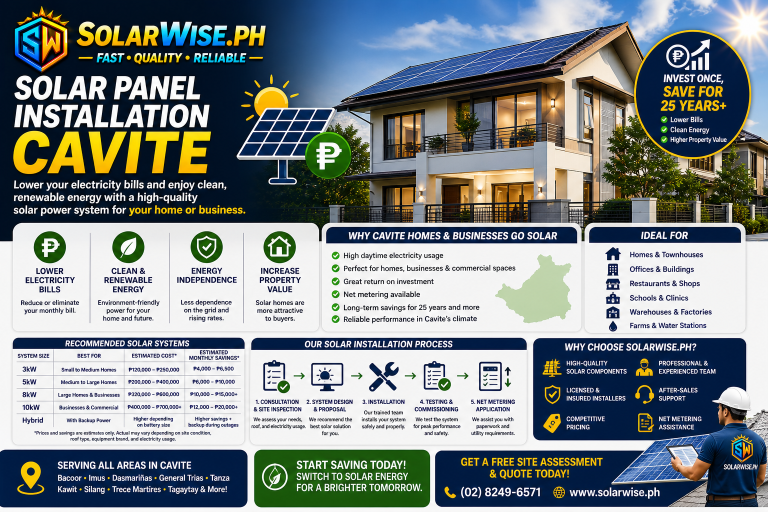
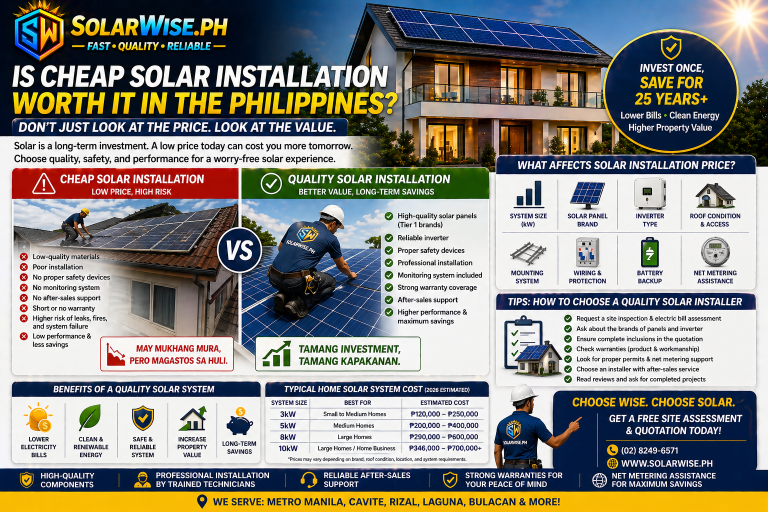
Solar panel installation cost in the Philippines depends on the system size, equipment brand, inverter type, roof condition, electrical work, and whether the system is grid-tied or hybrid.
As a general estimate, many residential solar systems in the Philippines may fall within this range:
| System Size | Estimated Cost Range | Best For |
|---|---|---|
| 3kW | ₱180,000 – ₱240,000 | Smaller homes, lower daytime usage |
| 5kW | ₱275,000 – ₱375,000 | Medium homes, ₱8,000–₱12,000 monthly bill range |
| 8kW | ₱440,000 – ₱600,000 | Larger homes, multiple aircon units |
| 10kW | ₱550,000 – ₱750,000 | Large homes or small businesses |
| 15kW+ | ₱825,000+ | Commercial or high-consumption properties |
These are only sample market ranges. Some public 2026 solar cost guides estimate residential on-grid systems around ₱55,000 to ₱75,000 per kW, with a typical 4kW to 5kW setup around ₱240,000 to ₱375,000 installed, depending on inclusions and site conditions.
The actual price can be higher or lower depending on the equipment used, installation complexity, roof type, and whether the quote includes net metering assistance or electrical upgrades.
What Affects Solar Panel Cost?
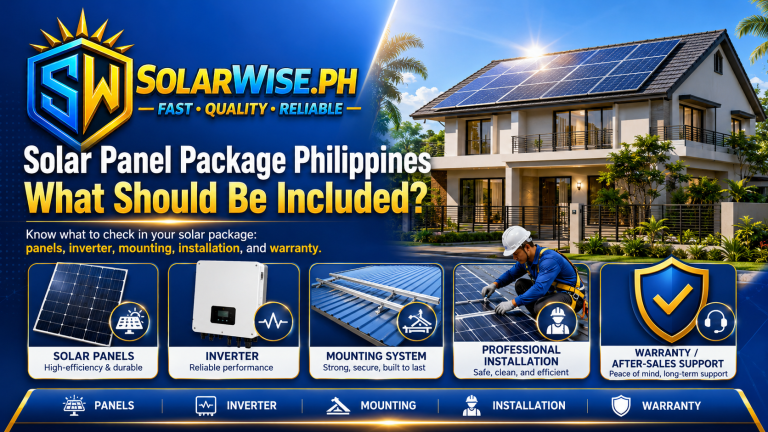
Solar cost is not based only on the number of panels. A complete system includes panels, inverter, mounting, wiring, protection devices, design, labor, testing, and after-sales support.
Main cost factors include:
1. System Size
The bigger the system, the more panels, wiring, mounting materials, and inverter capacity are needed.
A home with a ₱5,000 monthly bill may only need a small system, while a home with a ₱15,000 or ₱20,000 monthly bill may need a larger setup.
2. Grid-Tied vs Hybrid System
A grid-tied solar system is usually more affordable because it does not include batteries. It is ideal if your main goal is to lower your electricity bill.
A hybrid solar system costs more because it includes batteries or battery-ready equipment. It is ideal if you want backup power during brownouts.
If your priority is fastest return on investment, grid-tied solar is often the better starting point. If your priority is backup power and energy security, hybrid solar may be worth the extra cost.
3. Equipment Brand and Quality
Solar panels and inverters come in different brands, capacities, and warranty levels.
Higher-quality equipment may cost more upfront, but it can offer better performance, better warranty support, and more reliable long-term operation.
4. Roof Condition and Installation Difficulty
Your roof can affect the final price.
Installation may cost more if your roof is steep, fragile, hard to access, shaded, tiled, old, or has limited usable space.
Your solar provider should check:
- roof size,
- roof material,
- roof direction,
- shading,
- structural condition,
- wire routing,
- and inverter location.
5. Electrical Work
Some homes may need additional electrical work before or during installation.
This may include:
- breaker upgrades,
- protection devices,
- grounding,
- wire rerouting,
- panel board checking,
- or other safety improvements.
How Much Can You Save With Solar?
Solar savings depend on how much of your solar power you can use during the day.
For example, if your solar system produces electricity while your aircon, refrigerator, computer, water pump, or appliances are running, you buy less electricity from the grid.
Your savings are usually higher if:
- your home uses power during daytime,
- your solar system is properly sized,
- your roof has good sunlight exposure,
- your appliances match your solar production,
- and you have net metering for excess solar energy.
Solar does not always mean your bill becomes zero. A more realistic goal is to reduce your bill significantly and recover your investment over time.
Sample Solar Savings Based on Monthly Electric Bill
Here is a simple estimate:
| Monthly Electric Bill | Possible System Size | Main Goal |
|---|---|---|
| ₱5,000/month | Around 3kW | Reduce daytime grid use |
| ₱10,000/month | Around 5kW | Strong bill reduction |
| ₱15,000/month | Around 8kW | Larger savings potential |
| ₱20,000+/month | 10kW+ | Custom design needed |
A 5kW system is one of the most common residential solar setups because it can help many medium-sized homes reduce a large portion of daytime electricity usage.
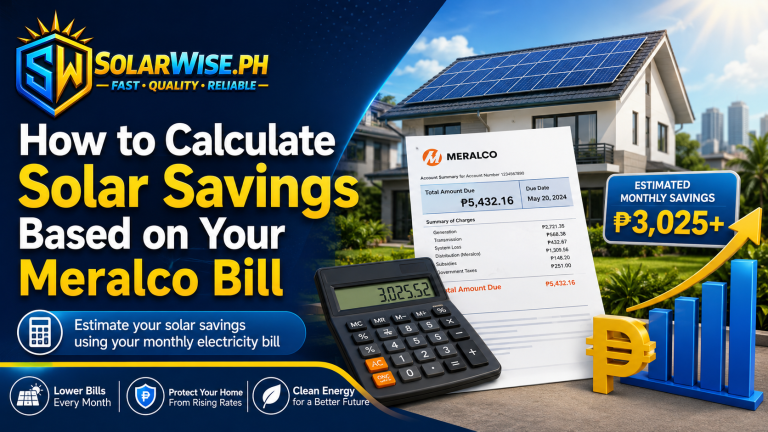
But your actual savings will depend on your kWh consumption, not just your peso bill. Two homes with the same Meralco bill can have different usage patterns, so they may need different system sizes.
What Is the Payback Period for Solar in the Philippines?
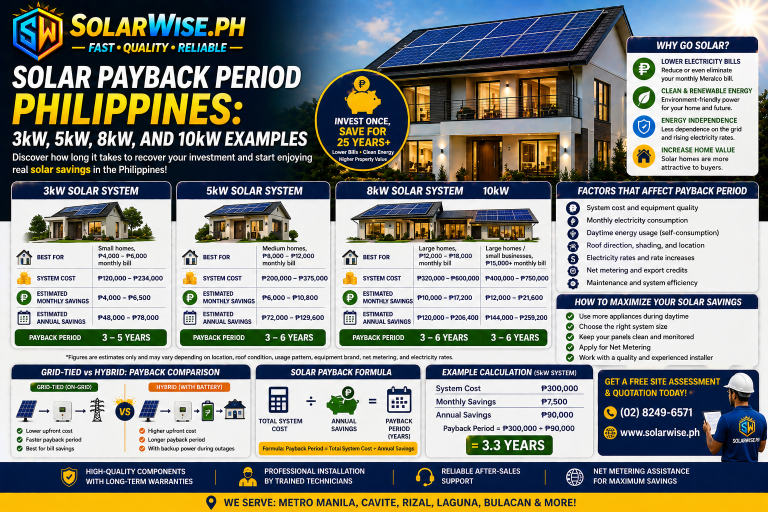
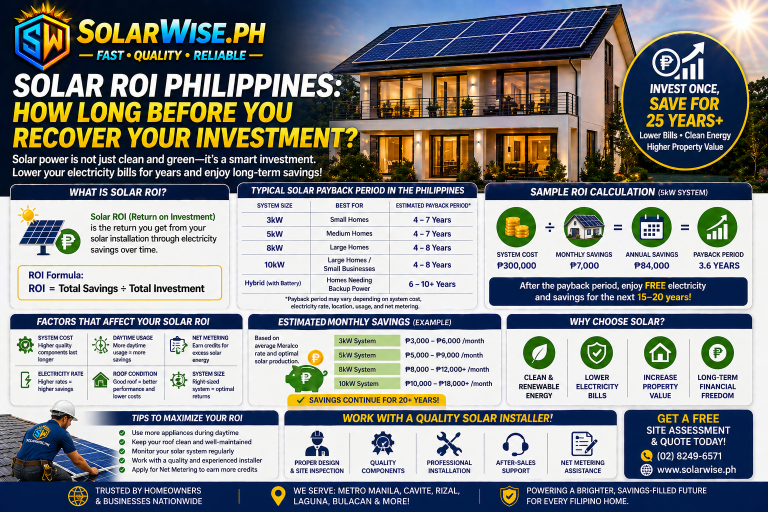
The payback period is the time it takes for your solar savings to recover the cost of installation.
For example:
Estimated monthly savings: ₱7,000
Estimated yearly savings: ₱84,000
Estimated payback period: around 4.2 years
In many cases, residential solar payback in the Philippines may fall around 3 to 7 years, depending on system cost, electricity usage, net metering, and actual solar production.
A shorter payback period is more likely if:
- your electric bill is high,
- your daytime usage is high,
- your system is properly sized,
- your roof has good sun exposure,
- installation cost is reasonable,
- and net metering is available.
A longer payback period may happen if:
- your bill is low,
- you use most electricity at night,
- your roof is shaded,
- you install batteries mainly for backup,
- or the system is oversized.
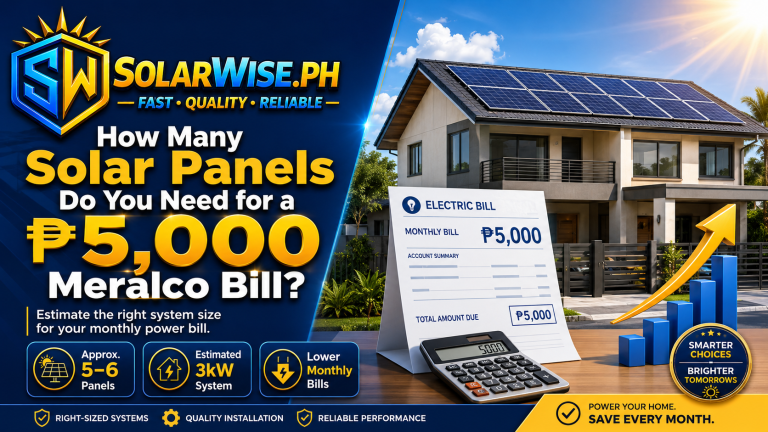
Is Solar Worth It for a ₱5,000 Monthly Bill?
Solar can still be worth it for a ₱5,000 monthly bill, but the system should be sized carefully.
A home with a ₱5,000 monthly bill may need around a 3kW solar system, depending on actual kWh usage and daytime consumption.
Solar may be worth it if:
- someone is home during the day,
- you use aircon or appliances during daytime,
- your roof has good sun exposure,
- and you want long-term bill reduction.
If your usage is mostly at night, the savings may be lower unless net metering or a hybrid setup is considered.
Is Solar Worth It for a ₱10,000 Monthly Bill?
Yes, a ₱10,000 monthly electric bill is often a strong candidate for solar.
A home with this bill range may need around a 5kW solar system, depending on usage and roof space.
Solar may be worth it because:
- the monthly bill is high enough to generate meaningful savings,
- a 5kW system can offset a good amount of daytime consumption,
- payback can be more attractive,
- and net metering may improve the overall return.
This is a common situation for homes in Metro Manila, Cavite, QC, Rizal, and South Metro Manila with air conditioning, work-from-home equipment, refrigerators, and other daytime appliances.
Is Solar Worth It for a ₱15,000 Monthly Bill?
Yes, solar is often very worth considering for homes with a ₱15,000 monthly electric bill.
A home in this range may need around an 8kW solar system, depending on actual kWh consumption, roof space, and daytime usage.
The higher the bill, the more opportunity there is to save, especially if the household uses electricity during the day.
This may apply to:
- larger homes,
- homes with multiple air conditioners,
- families with high daytime usage,
- work-from-home households,
- small businesses,
- offices,
- clinics,
- and commercial spaces.
What Is Net Metering and Why Is It Important?
Net metering can improve the value of solar because it allows excess solar electricity to be exported to the grid and credited on your bill.
Meralco explains that net metering is a program under RA 9513 where eligible customers can install a renewable energy facility up to 100kW at their property, and excess renewable energy exported to Meralco is given as credits on the next bill.
The Department of Energy also describes net metering as a scheme that allows electricity end-users to generate renewable electricity primarily for their own use and sell unused electricity to the grid.
In simple terms:
- Your solar panels produce electricity during the day.
- Your home uses solar power first.
- If your solar system produces more than you use, the excess can go to the grid.
- The exported electricity may become bill credits.
Meralco also notes that net metering uses a bi-directional meter to measure both imported and exported energy, helping customers get billed accurately.
Can Solar Make Your Electric Bill Zero?
Sometimes it can bring your bill very low, but a true zero bill is not guaranteed.
Your final bill depends on:
- system size,
- daytime usage,
- nighttime usage,
- net metering credits,
- weather,
- appliance habits,
- roof shading,
- and utility charges.
Even with solar, you may still have minimum charges, grid-related charges, or consumption at night when your solar panels are not producing electricity.
A better goal is not “zero bill.” A better goal is:
lower bill, good payback period, safe installation, and long-term savings.
Grid-Tied vs Hybrid: Which Has Better Payback?
For most homeowners, a grid-tied solar system usually has better payback because it has a lower upfront cost.
A hybrid solar system can still be worth it, but the value is not only financial. The additional value comes from battery backup and energy security.
Choose grid-tied solar if your goal is:
- lower electric bill,
- lower upfront cost,
- faster ROI,
- and net metering compatibility.
Choose hybrid solar if your goal is:
- backup power during brownouts,
- battery storage,
- selected appliances running during outages,
- and better energy security.
If you only want to reduce your monthly bill, grid-tied solar may be enough. If power interruptions are a major concern, hybrid solar may be worth the higher cost.
Who Benefits Most From Solar?
Solar is usually best for:
- homeowners with high electric bills,
- homes with good roof space,
- households using power during daytime,
- work-from-home professionals,
- small businesses,
- offices,
- clinics,
- restaurants,
- households with refrigerators or freezers,
- homes with aircon use during the day,
- and property owners planning to stay long-term.
Solar may not be ideal yet for:
- renters without owner approval,
- homes with very low electric bills,
- roofs with heavy shading,
- properties with limited roof space,
- homeowners planning to move soon,
- and households that use almost all power at night without net metering or batteries.
Is Solar Worth It in Metro Manila?
Yes, solar can be worth it for many Metro Manila homes, especially those with high Meralco bills and daytime aircon or appliance use.
Because roof space can be limited in some urban areas, proper system design is important. SolarWise PH can help check whether your roof has enough usable space and whether grid-tied or hybrid solar is better for your home.
Is Solar Worth It in Cavite?
Yes, solar can be a good investment for homes in Cavite, especially in areas like Bacoor, Imus, Dasmariñas, General Trias, and nearby communities.
Many Cavite homes have enough roof space for residential solar systems. If your bill is around ₱8,000 to ₱15,000 or higher, solar may be worth considering.
Is Solar Worth It in Quezon City?
Yes, many homes in Quezon City can benefit from solar because of high electricity usage from air conditioning, work-from-home setups, and household appliances.
Solar may be especially useful for larger homes, home offices, and small commercial properties.
Is Solar Worth It in Rizal?
Yes, solar can be worth it for homes in Antipolo, Cainta, Taytay, and nearby Rizal areas, especially if the roof has good sunlight exposure and minimal shading from trees or nearby structures.
A site assessment is important because some areas may have more shading depending on the property location and roof angle.
How to Know If Solar Is Worth It for Your Home
Before deciding, prepare these details:
- latest electric bill,
- monthly kWh consumption,
- daytime appliance usage,
- number of air conditioners,
- roof photos,
- property location,
- interest in net metering,
- and whether you need battery backup.
SolarWise PH can use this information to estimate your system size, possible savings, and payback period.
Common Mistakes When Calculating Solar ROI
Mistake #1: Looking Only at the Cheapest Price
A cheap solar system is not always the best investment. Poor equipment or poor installation can reduce performance and cause issues later.
Mistake #2: Ignoring Daytime Usage
Solar panels produce power during the day. If your home uses most electricity at night, your savings may be lower unless you use net metering or batteries.
Mistake #3: Oversizing the System
A bigger system is not always better. If your system produces too much unused electricity without net metering, you may not maximize the investment.
Mistake #4: Expecting Guaranteed Zero Bill
Solar can reduce your bill, but a zero bill is not guaranteed. A reliable installer should give realistic savings estimates.
Mistake #5: Not Checking Roof Shading
Shading can reduce solar production. Trees, nearby buildings, water tanks, walls, and antennas should be checked before installation.
FAQs About Solar Savings and Payback in the Philippines
Is solar worth it in the Philippines?
Yes, solar can be worth it if your monthly electric bill is high, your roof has good sunlight exposure, and you use electricity during the day. It is especially worth considering for homes with ₱5,000 to ₱15,000+ monthly electric bills.
How much does solar cost in the Philippines?
Residential solar cost depends on system size and project requirements. Public 2026 cost estimates show many residential on-grid systems around ₱55,000 to ₱75,000 per kW, with typical 4kW to 5kW systems around ₱240,000 to ₱375,000 installed.
How long is the payback period for solar panels?
Many residential solar systems may have a payback period of around 3 to 7 years, depending on system cost, electricity usage, solar production, and net metering. Homes with higher daytime usage usually recover the investment faster.
Can solar panels reduce my Meralco bill?
Yes. Solar panels can reduce your Meralco bill by powering your home during the day and reducing the electricity you buy from the grid. Net metering may also help by crediting excess exported solar energy.
Do I need net metering?
Net metering is not always required, but it can help improve savings if your system produces excess electricity during the day. Meralco says exported excess renewable energy can be converted into bill credits under its net metering program.
Is grid-tied or hybrid solar better for ROI?
Grid-tied solar usually has better ROI because it costs less upfront. Hybrid solar costs more because of batteries, but it may be worth it if you need backup power during brownouts.
Can solar make my bill zero?
It is possible in some cases, but not guaranteed. Your final bill depends on your usage, system size, net metering, weather, nighttime consumption, and utility charges.
What areas does SolarWise PH serve?
SolarWise PH serves the Philippines, especially Metro Manila, South Metro Manila, Cavite, Quezon City, Rizal, and nearby areas.
Final Thoughts: Is Solar Really Worth It?
For many Filipino homeowners, solar is worth it because it can lower monthly electric bills, provide long-term savings, and reduce dependence on the grid.
Solar is most worth it if:
you use electricity during the day,
your roof has good sunlight exposure,
you plan to stay long-term,
and your system is properly designed.
But solar should be sized correctly. The goal is not just to install many panels. The goal is to install the right solar system for your home, budget, usage, and location.
If you are in Metro Manila, Cavite, Quezon City, Rizal, South Metro Manila, Las Piñas, Muntinlupa, Parañaque, Bacoor, Imus, Dasmariñas, Antipolo, Cainta, or Taytay, SolarWise PH can help you check if solar is worth it for your property.
Ready to find out your possible savings and payback period?
Contact SolarWise PH today for a solar consultation and site assessment.
SolarWise PH — Fast. Quality. Reliable.