
Solar Payback Period Philippines: 3kW, 5kW, 8kW, and 10kW Examples
Kung nagpaplano kang magpa-install ng solar panels, isa sa pinaka-importanteng tanong is: gaano katagal bago mabawi ang puhunan? This is called the solar payback period Philippines homeowners should understand before investing in a solar power system.
In simple terms, solar payback period means the number of years it takes for your electricity savings to recover your solar installation cost. After that period, your solar panels can continue generating savings for many more years.
For many Filipino homeowners, the payback period depends on system size, installation cost, electricity rate, daytime usage, roof condition, shading, and net metering. Updated 2026 solar pricing guides show common residential systems such as 3kW, 5kW, 8kW, and 10kW can have estimated payback periods ranging from around 2.2 to 6+ years, depending on assumptions and actual usage. More conservative guides estimate many homeowners break even in about 6 to 9 years, especially when costs are higher or self-consumption is lower.
This guide includes sample 3kW, 5kW, 8kW, and 10kW examples so you can better understand your potential solar ROI.
What Is Solar Payback Period?
The solar payback period is the time it takes to recover your solar installation cost through monthly electric bill savings.
Formula:
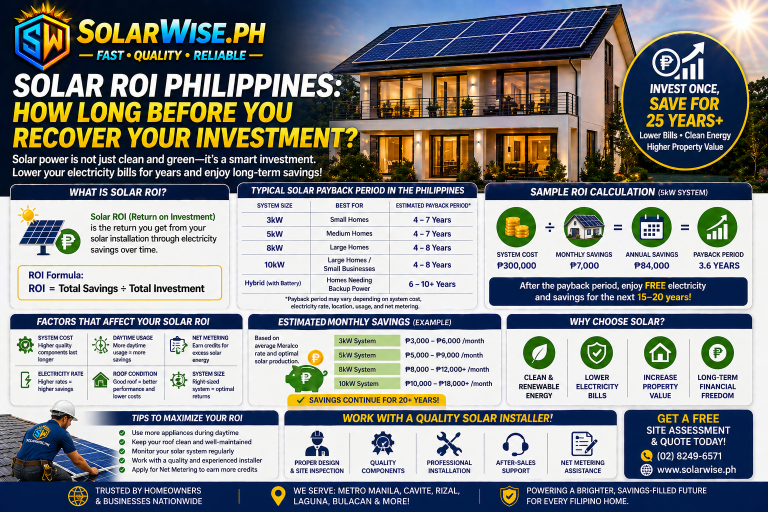
Solar Payback Period = Total Solar System Cost ÷ Annual Solar Savings
Example:
If your solar system costs ₱300,000 and saves ₱7,000 per month, your annual savings is ₱84,000.
₱300,000 ÷ ₱84,000 = 3.6 years
That means your estimated payback period is around 3.6 years. After that, your solar system can continue helping lower your electricity bill.
Why Solar Payback Period Matters
Solar is a long-term investment. Hindi lang ito one-time home upgrade. It can help reduce your monthly electricity bill for many years.
Knowing your payback period helps you understand:
How fast you can recover your investment
Whether 3kW, 5kW, 8kW, or 10kW is right for your home
How much your monthly savings may be
How net metering can affect your ROI
Whether grid-tied or hybrid solar is better for your goal
How to avoid overspending on the wrong system size
The goal is not just to install the biggest solar system. The goal is to install the right system for your actual usage.
Solar Savings Calculator Philippines: Simple Formula
You can use a simple solar savings calculator Philippines formula to estimate payback:
Step 1: Get total installed cost
Step 2: Estimate monthly savings
Step 3: Multiply monthly savings by 12
Step 4: Divide system cost by annual savings
Example:
| Item | Sample Value |
|---|---|
| Installed Cost | ₱300,000 |
| Monthly Savings | ₱7,000 |
| Annual Savings | ₱84,000 |
| Payback Period | 3.6 years |
Formula:
₱300,000 ÷ ₱84,000 = 3.6 years
This is only a sample calculation. Actual savings vary depending on electricity rate, system output, shading, usage pattern, and net metering.
Average Solar Payback Period in the Philippines
The average payback period depends on which price and savings assumptions are used. One 2026 price guide estimates payback at around 3.1 years for 3kW, 2.4 years for 5kW, 2.3 years for 8kW, and 2.2 years for 10kW under its cost and savings assumptions. Another 2026 guide gives more conservative estimates, with many systems around 4 to 6 years, while LakaSolar notes many Filipino homeowners may break even in 6 to 9 years depending on system size, cost, and consumption pattern.
A practical homeowner range is:
| System Size | Typical Payback Estimate | Best For |
|---|---|---|
| 3kW | 3 – 7 years | Small homes, around ₱5,000 bill |
| 5kW | 3 – 7 years | Medium homes, around ₱8,000–₱12,000 bill |
| 8kW | 3 – 8 years | Large homes, around ₱12,000–₱18,000 bill |
| 10kW | 3 – 8 years | Large homes or small businesses |
| Hybrid with Battery | 6 – 10+ years | Homes needing backup power |
3kW Solar Payback Period Example
A 3kW solar system is often used for small homes, townhouses, and households with around ₱4,000 to ₱6,000 monthly electricity bills.
Updated 2026 pricing guides estimate 3kW systems from around ₱120,000 to ₱234,000, depending on equipment and package inclusions. Monthly savings estimates vary from around ₱4,459 to ₱6,500 depending on the source and assumptions.
| 3kW Solar Example | Estimate |
|---|---|
| Installed Cost | ₱150,000 – ₱234,000 |
| Estimated Monthly Savings | ₱4,000 – ₱6,500 |
| Estimated Annual Savings | ₱48,000 – ₱78,000 |
| Sample Payback Period | 3 – 5 years |
Best For:
Small homes
Townhouses
₱5,000 monthly bill range
Work-from-home households
Refrigerator, fans, Wi-Fi, lights, laptop use
Small daytime appliance usage
A 3kW system is a good starting point for homeowners who want affordable solar and lower monthly bills without going too large.
5kW Solar Payback Period Example
A 5kW solar system is one of the most popular residential solar sizes in the Philippines. It is commonly used for medium homes with around ₱8,000 to ₱12,000 monthly electric bills.
For 2026, one guide estimates a 5kW system at ₱192,500 to ₱300,000 with around ₱7,432 monthly savings, while another guide estimates 5kW systems at ₱200,000 to ₱300,000 with around ₱10,800 monthly savings under its assumptions. More conservative Metro Manila guides estimate a 5kW system at around ₱275,000 to ₱375,000 with monthly savings of about ₱6,000 to ₱8,400.
| 5kW Solar Example | Estimate |
|---|---|
| Installed Cost | ₱200,000 – ₱375,000 |
| Estimated Monthly Savings | ₱6,000 – ₱10,800 |
| Estimated Annual Savings | ₱72,000 – ₱129,600 |
| Sample Payback Period | 3 – 6 years |
Best For:
Medium homes
₱10,000 monthly bill range
1 to 2 aircon units
Work-from-home setup
Refrigerator, washing machine, fans, Wi-Fi
Families with moderate to high daytime usage
A 5kW system often gives strong value because it balances installation cost, roof space, and monthly savings.
8kW Solar Payback Period Example
An 8kW solar system is usually recommended for larger homes with higher electricity usage, multiple appliances, and around ₱12,000 to ₱18,000 monthly bills.
A 2026 pricing guide estimates 8kW systems at around ₱289,520 to ₱451,200, with estimated monthly savings of around ₱11,891. Another guide estimates 8kW systems at ₱320,000 to ₱450,000 with around ₱17,200 monthly savings, while more conservative guides estimate 8kW systems at around ₱440,000 to ₱600,000 fully installed in some markets.
| 8kW Solar Example | Estimate |
|---|---|
| Installed Cost | ₱320,000 – ₱600,000 |
| Estimated Monthly Savings | ₱10,000 – ₱17,200 |
| Estimated Annual Savings | ₱120,000 – ₱206,400 |
| Sample Payback Period | 3 – 6 years |
Best For:
Large homes
₱15,000 monthly bill range
2 to 3 inverter aircon units
Large family households
High daytime appliance usage
Home office or home-based business
Refrigerators, freezers, water pumps
An 8kW system can be a strong option for homeowners who want bigger bill reduction and have enough roof space.
10kW Solar Payback Period Example
A 10kW solar system is commonly used for very large homes, home-based businesses, small offices, restaurants, clinics, water stations, laundries, and commercial spaces with high daytime usage.
For 2026, one guide estimates a 10kW system at ₱346,500 to ₱540,000 with monthly savings around ₱14,864, while another estimates ₱400,000 to ₱550,000 and savings around ₱21,600 monthly. Some broader market guides place 10kW systems around ₱550,000 to ₱750,000 fully installed depending on location and equipment.
| 10kW Solar Example | Estimate |
|---|---|
| Installed Cost | ₱400,000 – ₱750,000 |
| Estimated Monthly Savings | ₱12,000 – ₱21,600 |
| Estimated Annual Savings | ₱144,000 – ₱259,200 |
| Sample Payback Period | 3 – 6 years |
Best For:
Large homes
Small businesses
Commercial solar Philippines
₱15,000+ monthly bill range
High daytime electricity usage
Offices, clinics, stores, restaurants, warehouses
Home-based businesses
A 10kW system can have a strong payback period when most energy is used during the day.
Sample Solar Savings Calculator Table
Use this sample table as a quick solar savings calculator Philippines guide:
| System Size | Sample Cost | Sample Monthly Savings | Annual Savings | Estimated Payback |
|---|---|---|---|---|
| 3kW | ₱180,000 | ₱5,000 | ₱60,000 | 3.0 years |
| 5kW | ₱300,000 | ₱7,500 | ₱90,000 | 3.3 years |
| 8kW | ₱480,000 | ₱12,000 | ₱144,000 | 3.3 years |
| 10kW | ₱600,000 | ₱15,000 | ₱180,000 | 3.3 years |
These examples are simplified. Actual payback can be faster or slower depending on your actual installation cost, electric rate, self-consumption, net metering, weather, and roof condition.
Why Some Solar Payback Estimates Are Different
You may see different payback estimates from different solar companies or websites. This is normal because each calculator may use different assumptions.
Payback can change depending on:
System price
Electricity rate
Monthly kWh usage
Solar production estimate
Roof direction
Shading
Self-consumption rate
Net metering export credits
Installer package inclusions
Battery backup cost
Maintenance assumptions
A low-cost system with high self-consumption may show a faster payback. A premium system, shaded roof, or hybrid battery setup may show a longer payback.
How Net Metering Affects Solar Payback Period
Net metering can improve solar payback because excess solar energy can be exported to the grid and credited to your bill.
Meralco explains that net metering allows qualified customers to install a renewable energy facility up to 100kW, export excess renewable electricity, and receive credits on the next bill. Meralco also states that a bi-directional meter measures both import and export energy to ensure accurate billing.
This can help homeowners who produce more electricity than they use during the day. However, the best savings usually still come from using solar power directly in your home.
Self-Consumption vs Export Credits
Self-consumption means using solar electricity directly while your panels are producing power. This often gives better savings because it reduces electricity bought from the grid.
Export credits happen when your excess solar energy goes to the grid through net metering. These credits still help, but they may not always be equal to the full retail electricity rate.
To improve payback, use more appliances during the day when solar production is high.
Grid-Tied vs Hybrid Solar Payback
| Setup Type | Payback Speed | Best For |
|---|---|---|
| Grid-Tied Solar | Faster | Bill savings, net metering, lower upfront cost |
| Hybrid Solar | Slower | Savings plus backup power |
| Off-Grid Solar | Custom | Remote properties without grid access |
For fastest ROI, grid-tied solar is usually better because it has no battery cost. Hybrid solar is better if backup power during brownouts is important.
How to Improve Your Solar Payback Period
To recover your investment faster:
Choose the right system size
Use more power during daytime
Apply for net metering if grid-tied
Avoid unnecessary oversizing
Fix roof shading issues
Use a reliable inverter and panels
Monitor production regularly
Clean panels when needed
Choose a quality solar installer
Compare quotes by value, not just price
The fastest payback usually comes from a properly sized grid-tied system with strong daytime usage.
Local Solar Payback Period: Metro Manila, Cavite, Rizal, Laguna, and Bulacan
Solar payback can vary by location because labor cost, roof access, electricity usage, weather, and utility requirements may differ.
Metro Manila
Solar payback can be strong in Quezon City, Makati, Taguig, Pasig, Manila, Las Piñas, Muntinlupa, Parañaque, and Alabang because many homes and businesses have high electricity bills. However, installation costs in NCR may be higher due to labor and access conditions.
Cavite
Homes in Bacoor, Imus, Dasmariñas, General Trias, Tanza, Kawit, Silang, and Trece Martires often have good roof space, making solar a good long-term investment.
Rizal
Homes in Antipolo, Cainta, Taytay, Angono, Binangonan, San Mateo, and Rodriguez can benefit from solar, especially if daytime usage is high. Roof shading from trees or slopes should be checked.
Laguna and Bulacan
Homes and businesses in Laguna and Bulacan may have strong solar ROI, especially properties with wide roof areas and high daytime consumption.
Is a Shorter Payback Always Better?
Not always. A very short payback estimate can be attractive, but make sure it is realistic.
Check if the quote includes:
Quality solar panels
Reliable inverter
Proper mounting system
Protection devices
Monitoring system
Net metering support
Workmanship warranty
After-sales service
A slightly longer payback with better equipment and safer installation may be better than a cheap system with poor support.
Frequently Asked Questions
What is solar payback period Philippines?
Solar payback period Philippines refers to how many years it takes to recover your solar installation cost through monthly electricity savings.
How do I calculate solar payback period?
Divide your total installed solar cost by your yearly savings. For example, if your system costs ₱300,000 and saves ₱90,000 per year, the payback period is about 3.3 years.
What is the typical solar payback period in the Philippines?
Depending on cost and assumptions, many systems may pay back in around 3 to 7 years. More conservative estimates place many Filipino homeowners around 6 to 9 years, especially if installation cost is high or daytime usage is low.
Which system has the fastest payback: 3kW, 5kW, 8kW, or 10kW?
The fastest payback depends on usage and cost. Larger systems can have strong payback if the property has high daytime electricity use. A 5kW or 8kW system often gives strong value for many homes.
Does net metering improve payback?
Yes. Net metering can improve payback by turning excess solar power into bill credits. Meralco says qualified systems up to 100kW can export excess electricity and receive credits on the next bill.
Is grid-tied solar better for payback?
Usually, yes. Grid-tied solar often has faster payback because it costs less than hybrid solar with batteries.
Does hybrid solar have longer payback?
Usually, yes. Hybrid solar includes batteries, which increase upfront cost. It is better for backup power, not always fastest ROI.
Can solar make my bill zero?
Sometimes, but not always. You may still pay for nighttime usage, minimum charges, grid charges, taxes, and electricity used when solar production is low.
Conclusion
The solar payback period Philippines homeowners can expect depends on the system size, installed cost, monthly savings, electricity rate, net metering, and actual daytime usage.
As a practical guide, 3kW, 5kW, 8kW, and 10kW systems may recover their cost in around 3 to 7 years under strong savings conditions, while more conservative cases may take 6 to 9 years. The best way to know your real payback is to use a proper solar savings calculator Philippines estimate based on your actual electric bill, roof condition, and daily usage pattern.
Before installing, request an electric bill assessment and site inspection so your solar system can be properly sized, safely installed, and designed for long-term savings.