
Solar Panel Package Philippines: What Should Be Included?
Planning to install solar panels for your home or business?
Before choosing a solar provider, one important question you should ask is:
“Ano ba dapat ang kasama sa solar panel package?”
Many homeowners and business owners in the Philippines compare solar packages based only on price. But the cheapest package is not always the best choice.
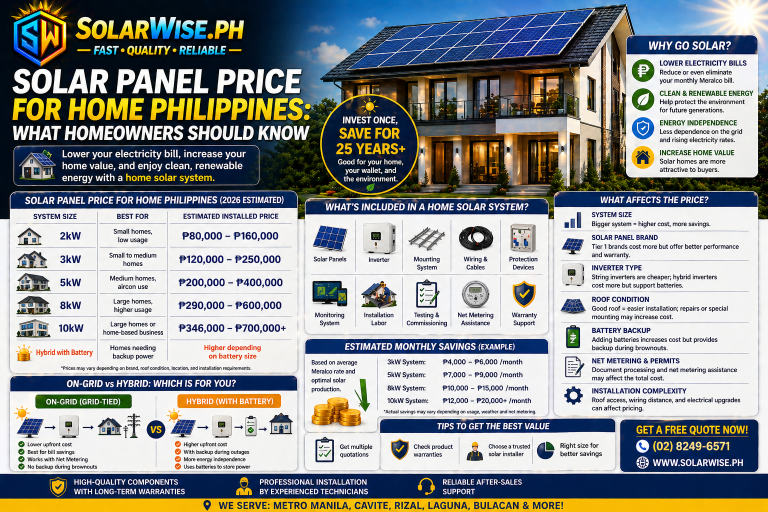
A good solar panel package Philippines offer should include the right equipment, proper system design, safe installation, quality mounting, clear warranty, and reliable after-sales support.
In this guide, we will explain what should be included in a complete solar panel package, so you can make a smarter decision before investing in solar.
Why You Should Check What Is Included in a Solar Package
Not all solar packages are the same.
Some packages may look cheaper, but important items may not be included.
For example, one package may include complete installation, mounting, protection devices, permits, and warranty.
Another package may only include panels and inverter, but other important materials or labor may be charged separately.
That is why you should not ask only:
“Magkano ang solar?”
You should also ask:
“Ano ang kasama sa package?”
This helps you avoid surprise costs, incomplete installation, or poor-quality materials.
1. Solar Panels
The solar panels are the most visible part of the system.
They are installed on your roof or mounting structure and convert sunlight into electricity.
A good solar panel package should clearly state:
Panel brand
Panel wattage
Number of panels
Total solar panel capacity
Panel warranty
Panel efficiency, if available
For example:
20 pcs 600W solar panels = 12kW solar panel capacity
The panel brand and wattage matter because they affect production, space requirement, and long-term performance.
Common trusted solar panel brands may include names such as Jinko, Trina, JA Solar, LONGi, Canadian Solar, AIKO, Sunket, and other available quality brands depending on stock and project requirement.
2. Solar Inverter
The inverter is one of the most important parts of your solar system.
Solar panels produce DC electricity. The inverter converts it into AC electricity that your home or business can use.
Your solar inverter Philippines package should clearly indicate:
Inverter brand
Inverter capacity
Type of inverter
Warranty coverage
Monitoring capability
Battery compatibility, if hybrid
Common inverter types include:
Grid-tied inverter
Hybrid inverter
Off-grid inverter
Microinverter system
For many homes and businesses, the inverter is the “brain” of the solar system.
That is why choosing the right inverter is very important.
3. Mounting System
The solar mounting system holds your panels securely on the roof or structure.
This is one of the most important parts of a solar installation, especially in the Philippines where we experience heavy rain, strong wind, and typhoons.
A good solar panel package should include proper mounting materials such as:
Rails
Clamps
Brackets
Roof hooks or mounting feet
Bolts and fasteners
Waterproofing materials, if needed
Structural support, if included
The mounting system should be suitable for your roof type.
Common roof types include:
Long span roof
Rib type roof
Tile roof
Concrete roof deck
Ground mount setup
Metal structure
A poor mounting system can cause leaks, weak panel support, or future safety issues.
That is why mounting should never be treated as a minor detail.
4. Complete Solar Installation
A complete solar installation Philippines package should include professional labor and system setup.
This normally includes:
Panel installation
Inverter installation
Battery installation, if included
Wiring and cabling
DC and AC connections
Electrical protection setup
System testing
Commissioning
Basic owner orientation
The installer should know proper solar wiring, safety standards, inverter settings, battery configuration, and load management.
Solar is not just “kabit panel.”
It is an electrical system that must be designed and installed correctly.
5. Electrical Protection Devices
A good solar package should include safety and protection components.
These may include:
DC breaker
AC breaker
Surge protection device
PV isolator
Battery breaker, if applicable
Combiner box, if needed
Grounding system
Proper cable protection
These devices help protect the system from electrical faults, surges, overloads, and unsafe operation.
Always ask if protection devices are included in the package.
A cheaper quote may not include the same level of safety materials.
6. Solar Cables and Connectors
Solar systems need the right cables and connectors.
A quality package should include appropriate materials such as:
PV cables
AC wires
Battery cables, if applicable
MC4 connectors or compatible connectors
Cable trays or conduits
Lugs and terminals
Cable ties and supports
Proper cable sizing is important because undersized wires can cause power loss, heating, and safety risks.
A professional solar installer should not use random wires just to lower the price.
7. Battery, If Hybrid or Off-Grid
If you are choosing a hybrid or off-grid solar system, the package should clearly include battery details.
Check the following:
Battery brand
Battery capacity
Battery voltage
Battery chemistry
Usable capacity
Warranty
Number of battery units
Backup load capacity
Battery communication with inverter
Common battery options include lithium batteries such as 51.2V systems used for hybrid solar setups.
The battery is important if you want:
Nighttime solar usage
Brownout backup
Off-grid power
More energy independence
But remember, battery size should be based on your actual load requirement.
A small battery may not support all appliances during a brownout.
8. Monitoring System
Many modern solar systems include app-based monitoring.
This helps you check:
Solar production
Battery charge level
Home consumption
Grid import
Grid export, if applicable
Inverter status
System alerts
Monitoring is useful because it helps you understand how your system is performing daily.
Ask your provider if online monitoring is included and if WiFi setup assistance is part of the installation.
9. System Design and Load Assessment
A good solar provider should not recommend a package without checking your usage.
Proper system design should consider:
Monthly electric bill
kWh consumption
Roof space
Roof direction
Shading
Appliances
Daytime and nighttime usage
Main breaker
Single-phase or three-phase setup
Battery backup requirement
Grid-tied, hybrid, or off-grid preference
This is very important because the right system for one home may not be right for another.
Solar should be designed based on actual consumption, not guesswork.
10. Net Metering Assistance, If Applicable
For grid-tied solar systems, net metering may help improve savings by allowing eligible customers to export excess solar energy back to the grid for credits.
A solar package may include or offer assistance with:
Net metering application
Document preparation
Single-line diagram
System requirements
Coordination guidance
Utility requirements
Ask your provider clearly if net metering assistance is included, optional, or charged separately.
11. Permits and Documentation
Depending on the project type and location, permits and documentation may be required.
A professional solar package may include or assist with:
System design documents
Electrical plan
Single-line diagram
Equipment datasheets
Warranty documents
Installation report
Testing and commissioning report
Net metering documents, if applicable
For commercial projects, documentation is even more important because of safety, insurance, compliance, and internal approval requirements.
12. Warranty Coverage
Warranty is one of the most important parts of any solar package.
A complete solar panel warranty Philippines offer should clearly state:
Solar panel warranty
Inverter warranty
Battery warranty, if included
Workmanship warranty
Mounting warranty, if applicable
Service warranty
Warranty process
Parts and labor coverage
Warranty is not just about how many years are written on the quotation.
You also need to know who will assist you if there is a problem.
A good solar company should explain what is covered and what is not covered.
13. Workmanship Warranty
Aside from equipment warranty, workmanship warranty is also important.
This covers the quality of installation work.
Workmanship warranty may cover concerns related to:
Installation quality
Loose mounting, if caused by installation error
Wiring workmanship
Improper connection
Installation-related issues
Ask the provider how long the workmanship warranty is and what the process is if you need service.
14. After-Sales Support
Solar is a long-term system.
That is why after-sales support matters.
A good solar provider should be able to assist with:
Monitoring concerns
Inverter settings
Battery issues
System checkup
Troubleshooting
Warranty claims
Maintenance guidance
Performance questions
Avoid choosing a provider that disappears after installation.
A slightly cheaper package may become more expensive later if there is no support.
15. Clear Scope of Work
Before approving a solar package, ask for a clear scope of work.
The quote should explain:
What is included
What is not included
Equipment list
Installation scope
Payment terms
Project timeline
Warranty terms
Possible additional charges
Client responsibilities
Roof or electrical exclusions
This protects both the client and the solar company from misunderstanding.
Grid-Tied, Hybrid, and Off-Grid Package Inclusions
The inclusions may vary depending on the type of solar system.
Grid-Tied Solar Package
A grid-tied package usually includes:
Solar panels
Grid-tied inverter
Mounting system
Solar cables
AC/DC protection
Installation
Monitoring
Testing and commissioning
Optional net metering assistance
This is often best for homes and businesses with strong daytime usage and access to the utility grid.
Hybrid Solar Package
A hybrid solar package usually includes:
Solar panels
Hybrid inverter
Battery storage
Mounting system
Solar cables
AC/DC protection
Battery protection
Installation
Monitoring
Backup load setup
Testing and commissioning
This is ideal for clients who want savings plus battery backup during brownouts.
Off-Grid Solar Package
An off-grid solar package usually includes:
Solar panels
Off-grid or hybrid inverter
Battery bank
Charge controller, if separate
Mounting system
Solar cables
Protection devices
Installation
Load assessment
Backup planning
Testing and commissioning
Off-grid systems need careful sizing because there is no utility grid to support the load when solar and battery are not enough.
Common Mistake: Comparing Only the Price
One of the biggest mistakes when buying solar is comparing only the total price.
For example:
Package A may be cheaper but has fewer panels, lower inverter quality, no battery, weak mounting, no proper protection devices, and limited warranty.
Package B may cost more but includes better design, complete installation, quality materials, monitoring, warranty, and after-sales support.
The better question is not only:
“Which is cheaper?”
The better question is:
“Which package gives better value, safety, savings, and support?”
Questions to Ask Before Buying a Solar Package
Before choosing a solar provider, ask these questions:
What is the total system size?
What panel brand and wattage are included?
What inverter brand and capacity are included?
Is the mounting system included?
Are breakers and protection devices included?
Are cables and connectors included?
Is battery included?
Is installation included?
Is monitoring included?
Is net metering assistance included?
What warranties are included?
How long is the workmanship warranty?
What happens if there is a problem after installation?
Are there possible additional charges?
Is the package based on my actual Meralco bill and usage?
These questions help you compare solar packages more accurately.
What Makes a Good Solar Panel Package in the Philippines?
A good solar panel package Philippines offer should be:
Properly sized
Safe
Complete
Transparent
Based on actual usage
Installed by experienced technicians
Supported by clear warranty
Backed by after-sales service
Suitable for Philippine weather
Designed for long-term savings
Solar is a long-term investment.
Choosing the right package can affect your savings, safety, and system performance for many years.
Final Thoughts
A solar panel package in the Philippines should include more than just panels.
A complete package should include the inverter, mounting, installation, cables, protection devices, monitoring, warranty, and after-sales support.
If you are choosing a hybrid or off-grid system, the package should also clearly include battery details and backup load planning.
Before you decide, always check what is included, what is excluded, and whether the system is designed based on your actual electricity usage.
At SolarWise.PH, we help homeowners and businesses choose the right solar package based on their Meralco bill, roof space, appliance usage, and energy goals.
Message SolarWise.PH today for a FREE solar estimate.
Serving Metro Manila: Quezon City, Makati, Taguig, Pasig, Parañaque, Las Piñas.