Hybrid Solar System Philippines: Is Battery Backup Worth It?
Kung gusto mong magpa-solar hindi lang para makatipid sa electric bill kundi para magkaroon din ng backup power during brownouts, one of the best options to consider is a hybrid solar system Philippines setup. Unlike a standard on-grid solar system, hybrid solar can combine solar panels, grid connection, and battery storage in one system.
For many Filipino homeowners, the big question is: worth it ba ang battery backup?
The answer depends on your goal. If ang priority mo ay lowest upfront cost and faster bill savings, a standard on-grid solar system may be enough. Pero kung gusto mo ng backup power for lights, Wi-Fi, CCTV, refrigerator, fans, work-from-home equipment, or selected appliances during outages, then a hybrid solar system may be worth the investment.
This guide explains how hybrid solar works, its pros and cons, estimated cost, best use cases, and whether battery backup is right for your home in the Philippines.
What Is a Hybrid Solar System?
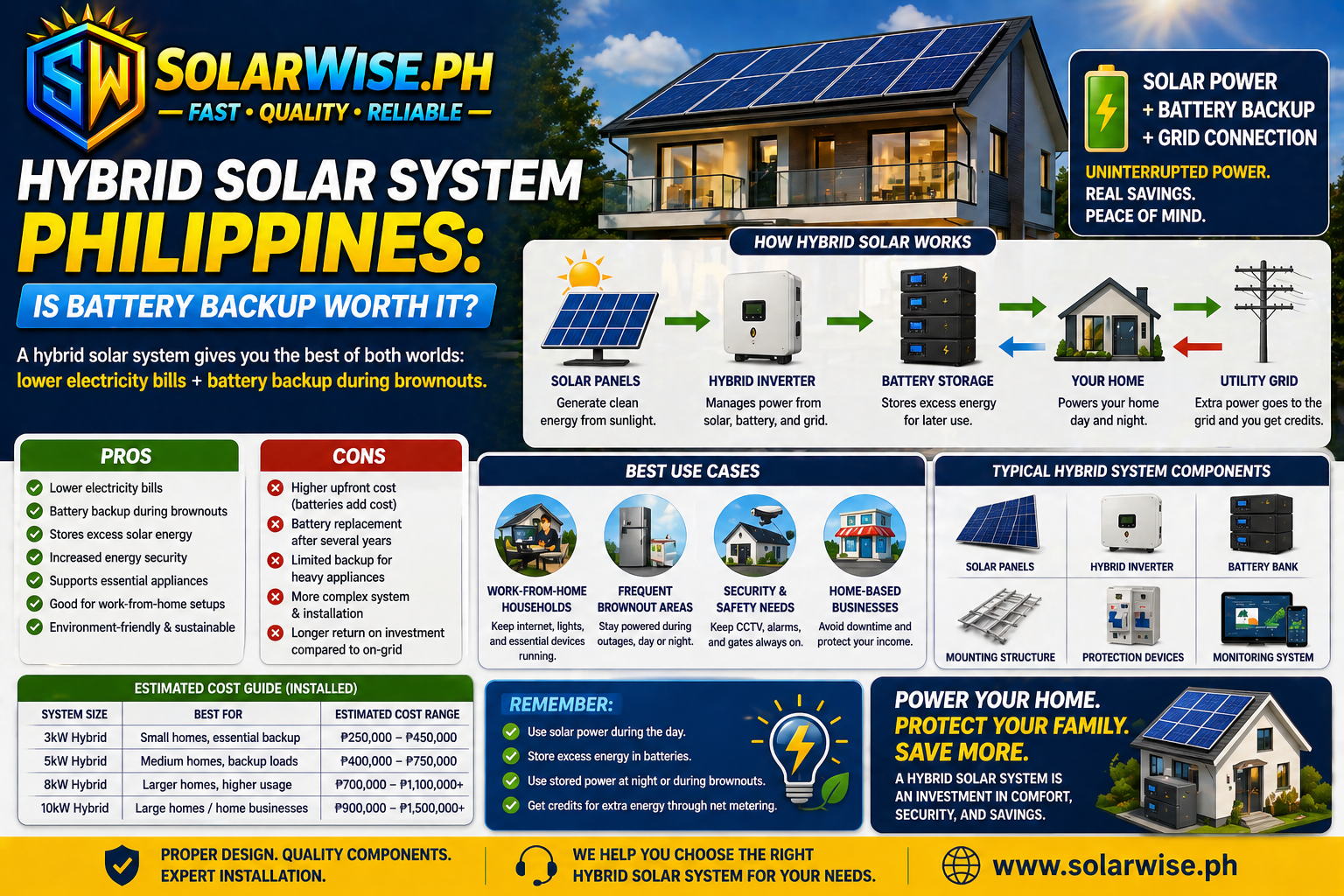
A hybrid solar system Philippines setup is a solar power system that combines solar panels, a hybrid inverter, battery storage, and grid connection. It allows your home to use solar energy during the day, store extra solar power in batteries, and still draw electricity from the grid when needed.
A typical hybrid solar system includes:
Solar panels
Hybrid inverter
Solar battery or battery bank
Mounting structure
DC and AC wiring
Protection devices
Backup load panel
Monitoring system
Grid connection
Optional net metering setup, depending on system design and utility approval
In simple terms, hybrid solar gives you both solar savings and backup power.
How Does a Hybrid Solar System Work?
A hybrid solar system works by managing energy from multiple sources: solar panels, batteries, and the grid.
During the day, your solar panels generate electricity. Your home uses solar power first. If your panels produce more electricity than your home needs, the extra power can charge your batteries. Once the batteries are full, excess power may be exported to the grid if your system is approved for net metering, or it may be limited depending on the system design.
At night or during low sunlight, your home can use stored energy from the batteries or draw power from the grid.
During a brownout, the hybrid inverter can supply power from the batteries to selected backup loads, depending on your system configuration.
Hybrid Solar vs On-Grid Solar
A standard on-grid solar system is connected to the utility grid and helps lower your electricity bill. However, most standard on-grid systems shut down during power outages for safety reasons.
A hybrid solar system includes batteries and can provide backup power to selected circuits during outages.
| Feature | On-Grid Solar | Hybrid Solar |
|---|---|---|
| Lowers electric bill | Yes | Yes |
| Uses solar power during daytime | Yes | Yes |
| Battery backup | No | Yes |
| Works during brownouts | Usually no | Yes, for selected loads |
| Upfront cost | Lower | Higher |
| Maintenance | Lower | Moderate |
| Best for | Bill savings | Savings + backup power |
If your main goal is lower bills, on-grid solar may be enough. If your main concern is brownouts and power security, hybrid solar is better.
Is Battery Backup Worth It?
Battery backup is worth it if you need reliable power during outages or if power interruptions affect your work, safety, comfort, or business.
A hybrid solar system may be worth it if:
You work from home and need Wi-Fi and laptop power
You need CCTV and security systems running
You want refrigerator backup during outages
You have elderly family members or medical equipment
You run a home-based business
Your area experiences frequent brownouts
You want more energy independence
You are willing to invest more upfront
Battery backup may not be worth it if:
Your area rarely has power outages
Your main goal is only to lower your bill
You want the fastest ROI
Your budget is limited
You do not need power at night or during brownouts
You are okay using the grid when solar is not available
For many homes in Metro Manila, Cavite, Rizal, Laguna, and Bulacan, hybrid solar is ideal when electricity savings and backup power are both important.
Pros of a Hybrid Solar System
1. Backup Power During Brownouts
The biggest advantage of a hybrid solar system is backup power. During outages, your battery can supply selected loads such as lights, Wi-Fi, CCTV, refrigerator, fans, and essential outlets.
2. Better Energy Security
Hybrid solar gives you more control over your electricity. Hindi ka totally dependent sa grid, especially during power interruptions.
3. Stores Excess Solar Energy
Instead of sending all excess solar power to the grid, your system can store energy in batteries for later use. This is useful for nighttime loads or emergency backup.
4. Can Reduce Monthly Electricity Bills
Like on-grid solar, hybrid solar can reduce your electricity bill by allowing your home to use solar power during the day.
5. Useful for Work-from-Home Homes
If you depend on internet, laptop, lights, and charging devices, battery backup can help you continue working during outages.
6. Good for Security and Essential Appliances
Hybrid solar can keep CCTV, routers, refrigerators, and selected lights running when the grid is down.
7. Future-Ready Solar Setup
Hybrid systems are more flexible because they are battery-ready and can be expanded depending on inverter and battery compatibility.
Cons of a Hybrid Solar System
1. Higher Upfront Cost
Hybrid solar costs more than on-grid solar because of the hybrid inverter, batteries, backup wiring, and additional protection devices.
2. Battery Replacement Over Time
Solar batteries do not last forever. Depending on battery type, usage, and maintenance, they may need replacement after several years.
3. Limited Backup Capacity
Battery backup does not mean your whole house can run normally during brownouts. Most systems are designed for selected essential loads only.
4. More Complex System Design
Hybrid solar needs proper load planning. Your installer must identify which circuits should be backed up and how long your batteries can support them.
5. Longer Payback Period
Because batteries add cost, hybrid solar may have a longer return on investment compared to a simple on-grid solar setup.
Estimated Cost of Hybrid Solar System Philippines
The cost of a hybrid solar system Philippines setup depends on solar system size, battery capacity, inverter brand, battery type, roof condition, backup load requirements, and installation complexity.
Here is a practical estimated guide:
| Hybrid Solar Size | Best For | Estimated Cost Range |
|---|---|---|
| 3 kW Hybrid | Small homes, essential backup | ₱250,000 – ₱450,000 |
| 5 kW Hybrid | Medium homes, backup loads | ₱400,000 – ₱750,000 |
| 8 kW Hybrid | Larger homes, higher usage | ₱700,000 – ₱1,100,000+ |
| 10 kW Hybrid | Large homes or home-based businesses | ₱900,000 – ₱1,500,000+ |
These are estimated ranges only. Actual pricing depends heavily on battery size and brand. A system with larger battery capacity will cost more than one designed only for lights, Wi-Fi, and selected appliances.
What Can Battery Backup Power?
Battery backup should be planned carefully. Hindi automatic na buong bahay ang kaya patakbuhin ng battery.
Common backup loads include:
LED lights
Wi-Fi router
CCTV system
Laptop or computer
Phone charging
Electric fan
Refrigerator
Selected outlets
Small appliances
High-power appliances like aircon, electric stove, microwave, washing machine, water heater, and large pumps may require a much bigger battery and inverter capacity. These can significantly increase the system cost.
Recommended Battery Backup Setup by Need
| Backup Need | Suggested Setup |
|---|---|
| Basic backup | Lights, Wi-Fi, phone charging |
| Home office backup | Lights, Wi-Fi, laptop, fan, selected outlets |
| Food protection | Refrigerator plus basic loads |
| Security backup | CCTV, Wi-Fi, lights, selected outlets |
| Comfort backup | Fans, refrigerator, lights, Wi-Fi |
| Larger backup | Custom battery and inverter sizing |
The best hybrid solar setup should be designed based on what you actually need during an outage.
Best Use Cases for Hybrid Solar in the Philippines
Homes with Frequent Brownouts
If your area experiences regular power interruptions, hybrid solar can provide peace of mind.
Work-from-Home Households
A hybrid system can keep Wi-Fi, lights, laptop, and essential outlets running during outages.
Homes with Elderly Family Members
Backup power can help keep lights, fans, communication devices, and important appliances available.
Homes with Refrigerators or Freezers
Battery backup can help protect food and frozen goods during long outages.
Home-Based Businesses
Hybrid solar is useful for online sellers, clinics, small offices, sari-sari stores, water stations, and other businesses that need continuous power.
Security-Conscious Homes
CCTV, gates, routers, and basic lighting can continue operating during outages.
Best Areas for Hybrid Solar System Installation
Hybrid solar system installation is suitable in many areas of the Philippines, especially where homeowners want both savings and backup power.
Common service areas include:
Metro Manila
Quezon City
Makati
Taguig
Pasig
Mandaluyong
Manila
Las Piñas
Muntinlupa
Parañaque
Alabang
Cavite
Bacoor
Imus
Dasmariñas
General Trias
Tanza
Rizal
Antipolo
Cainta
Taytay
Laguna
Biñan
Santa Rosa
San Pedro
Bulacan
These local keywords help your blog rank for searches such as hybrid solar system Metro Manila, hybrid solar system Cavite, hybrid solar Rizal, and solar battery backup near me Philippines.
Hybrid Solar and Net Metering
Some hybrid systems can be designed to work with net metering, but it depends on the inverter, system design, utility rules, and approval process.
If your hybrid system is grid-connected and exports excess energy, it must comply with utility requirements. For Meralco-served areas, your installer should confirm whether your hybrid inverter and system configuration are acceptable for net metering or if it will be set up as zero export.
This is why it is important to choose a solar installer who understands both hybrid solar design and utility requirements.
How to Choose the Right Battery Size
Choosing the right battery size depends on:
Which appliances need backup
How many hours of backup you want
Your inverter capacity
Your budget
Daily solar production
Available roof space
Whether you want whole-house or essential-load backup
A good installer should calculate your backup loads in watts and estimate how long your battery can support them.
For example, backing up lights, Wi-Fi, and a few outlets is much cheaper than backing up aircon and heavy appliances.
Step-by-Step Hybrid Solar Installation Process
1. Electric Bill and Load Assessment
The installer checks your electricity bill and identifies your daytime usage and backup power needs.
2. Backup Load Planning
You decide which appliances or circuits should continue working during brownouts.
3. Site Inspection
Your roof, electrical panel, inverter location, battery location, and cable routes are inspected.
4. System Design
The installer designs the solar panel capacity, hybrid inverter size, battery capacity, and backup load panel.
5. Quotation
You receive a detailed quote including solar panels, inverter, batteries, wiring, protection devices, installation, monitoring, warranties, and possible net metering support.
6. Installation
The solar panels, hybrid inverter, battery, wiring, breakers, and backup circuits are installed.
7. Testing and Commissioning
The installer tests solar production, battery charging, backup mode, grid connection, safety devices, and monitoring system.
8. Monitoring and Maintenance
After installation, your system should be monitored regularly to ensure proper battery health and energy performance.
Maintenance Tips for Hybrid Solar Systems
Hybrid solar systems need more monitoring than standard on-grid systems because of the battery.
Maintenance tips include:
Check the monitoring app regularly
Keep batteries in a safe and ventilated location
Avoid overloading backup circuits
Keep panels clean from heavy dirt or leaves
Schedule inspection after typhoons or strong storms
Follow manufacturer battery usage guidelines
Ask your installer for annual system checkups
Proper maintenance helps extend battery life and system performance.
How to Choose a Hybrid Solar Installer
Choose a solar provider that understands both solar savings and battery backup design.
Look for:
Proper electric bill assessment
Backup load calculation
Actual site inspection
Correct battery sizing
Quality solar panels
Reliable hybrid inverter
Safe battery installation
Proper protection devices
Workmanship warranty
Equipment warranty
Monitoring setup
After-sales support
Net metering or zero-export guidance
Transparent quotation
A trusted installer should explain what your battery can and cannot power during outages.
Frequently Asked Questions
What is a hybrid solar system Philippines?
A hybrid solar system combines solar panels, battery storage, hybrid inverter, and grid connection. It allows your home to use solar power, store energy in batteries, and draw from the grid when needed.
Is battery backup worth it for solar homes?
Battery backup is worth it if you need power during outages, work from home, run important appliances, or want better energy security. If your only goal is lower bills, on-grid solar may be more cost-effective.
How much does a hybrid solar system cost in the Philippines?
A 3 kW hybrid solar system may cost around ₱250,000 to ₱450,000, while 5 kW systems may range from ₱400,000 to ₱750,000 or more depending on battery capacity and equipment.
Can hybrid solar power my whole house during brownouts?
It depends on inverter size and battery capacity. Most residential hybrid systems are designed for essential loads, not the entire house.
Can a hybrid solar system run aircon?
Yes, but it requires a larger inverter and battery capacity. Running aircon on battery backup can significantly increase system cost.
Does hybrid solar work at night?
Yes, if the batteries have stored energy. Otherwise, the system can draw power from the grid.
Can hybrid solar apply for net metering?
Some hybrid systems may apply for net metering if they meet utility requirements. Your installer should confirm the correct setup before installation.
What is better: on-grid or hybrid solar?
On-grid solar is better for lower upfront cost and faster bill savings. Hybrid solar is better if you need backup power during outages.
Conclusion
A hybrid solar system Philippines setup can be worth it for homeowners who want both electricity savings and battery backup. It is especially useful for families with work-from-home setups, refrigerators, CCTV, Wi-Fi, essential appliances, or frequent brownout concerns.
However, hybrid solar costs more than standard on-grid solar because of the batteries and additional system components. If your main goal is to lower your monthly bill, on-grid solar may be the better starting option. If you want backup power and more energy security, hybrid solar is a smart long-term investment.
Before installing, start with an electric bill assessment, backup load planning, and site inspection. This ensures your hybrid solar system is properly sized, safely installed, and designed for your actual needs.