
Solar Panel Installation Philippines: Complete Guide for Homeowners
Thinking about installing solar panels at home?
With electricity bills continuing to be a major concern for Filipino households, more homeowners in the Philippines are now looking at solar power as a long-term solution. Whether you live in Metro Manila, Cavite, Quezon City, Rizal, South Metro Manila, or nearby areas, a properly designed solar panel system can help reduce your monthly electric bill and give your home a more reliable source of clean energy.
But before you install solar panels, it is important to understand how the process works, what type of system you need, how much roof space is required, and whether net metering is right for your home.
This complete guide will help you understand everything you need to know about solar panel installation in the Philippines.
What Is Solar Panel Installation?
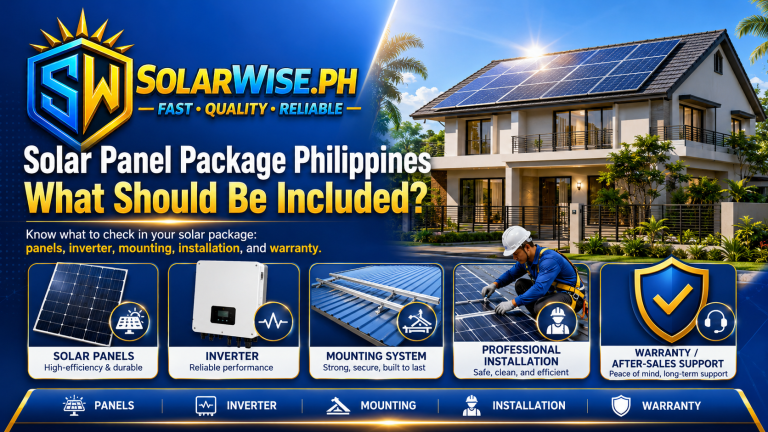
Solar panel installation is the process of setting up a solar power system on your home or property. The system uses solar panels to capture sunlight and convert it into electricity that can help power your appliances during the day.
A typical residential solar installation includes:
- solar panels,
- inverter,
- mounting structure,
- electrical wiring,
- protection devices,
- monitoring system, if available,
- testing and commissioning,
- and net metering assistance, if applicable.
The goal is simple: generate your own electricity from sunlight so you can reduce the amount of power you buy from the grid.
For many homeowners, solar is not just about saving money. It is also about long-term energy security, cleaner power, and protection from rising electricity costs.
Is Solar Panel Installation Worth It in the Philippines?
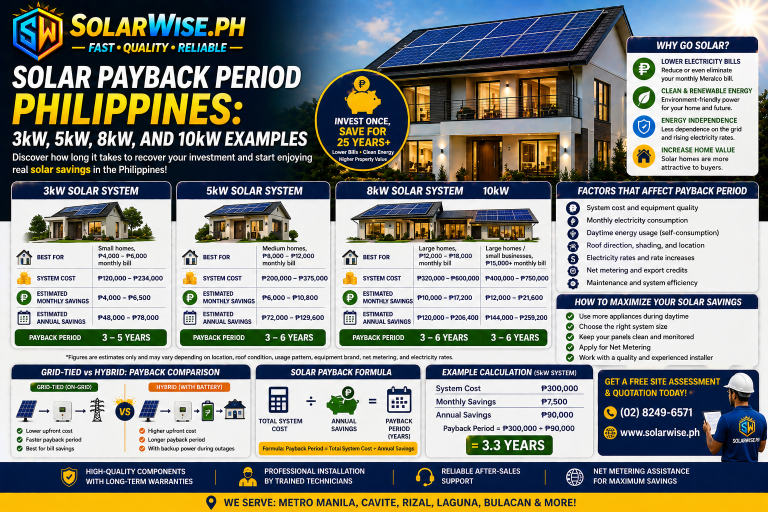
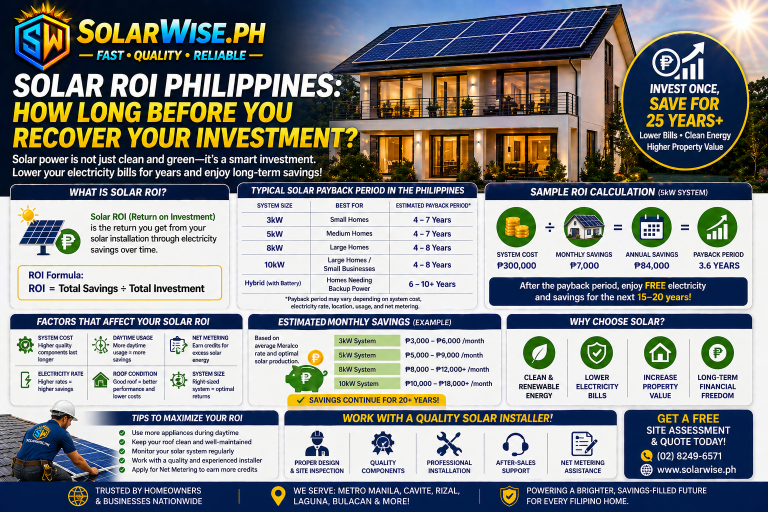
For many homes in the Philippines, solar panel installation can be worth it, especially if you have a high monthly electric bill and use electricity during daytime.
Solar may be a good option if:
- your monthly electric bill is around ₱5,000 or higher,
- you use air conditioning during the day,
- someone works from home,
- you have appliances running during daytime,
- your roof has good sun exposure,
- you plan to stay in the property for several years,
- and you want to lower long-term electricity expenses.
Solar is especially practical for homes in areas like Metro Manila, Cavite, Quezon City, Rizal, Las Piñas, Muntinlupa, Parañaque, Bacoor, Imus, Dasmariñas, Antipolo, Cainta, and Taytay, where many households have medium to high electricity usage.
Types of Solar Power Systems for Homes
Before installing solar panels, you need to know which solar system type fits your home.
1. Grid-Tied Solar System
A grid-tied solar system is connected to your home and to the utility grid. This is usually the most common and cost-effective solar setup for homeowners.
During the day, your solar panels generate electricity for your home. If your appliances need more power than your solar system produces, your home can still get electricity from the grid.
A grid-tied solar system is best for homeowners who want:
- lower monthly electricity bills,
- faster return on investment,
- simple system setup,
- lower upfront cost compared to battery systems,
- and possible net metering application.
This is often the recommended starting point for many homes in Metro Manila, Cavite, QC, and Rizal.
2. Hybrid Solar System
A hybrid solar system combines solar panels, grid connection, and battery storage. This type of setup allows you to use solar power during the day and store some energy in batteries for later use.
A hybrid system is usually more expensive than a grid-tied system because of the battery and hybrid inverter.
A hybrid solar system is best for homeowners who want:
- backup power during brownouts,
- better energy security,
- battery storage,
- solar power even during selected outages,
- and more control over energy usage.
This may be a good option if your area experiences frequent power interruptions or if you need backup for important appliances.
3. Off-Grid Solar System
An off-grid solar system is not connected to the utility grid. It uses solar panels and batteries to power a property independently.
This is usually used for farms, remote homes, rest houses, or properties where grid connection is unavailable or unreliable.
An off-grid solar system is best for:
- remote locations,
- farms,
- rest houses,
- properties without grid access,
- and homeowners who want independent power.
For regular homes in cities and subdivisions, grid-tied or hybrid systems are usually more practical.
How Does Solar Panel Installation Work?
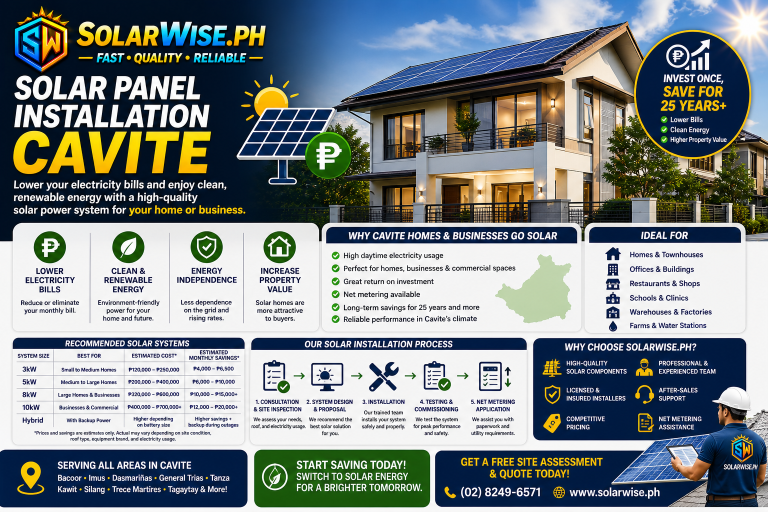
Here is the usual process for residential solar panel installation in the Philippines.
Step 1: Check Your Electric Bill
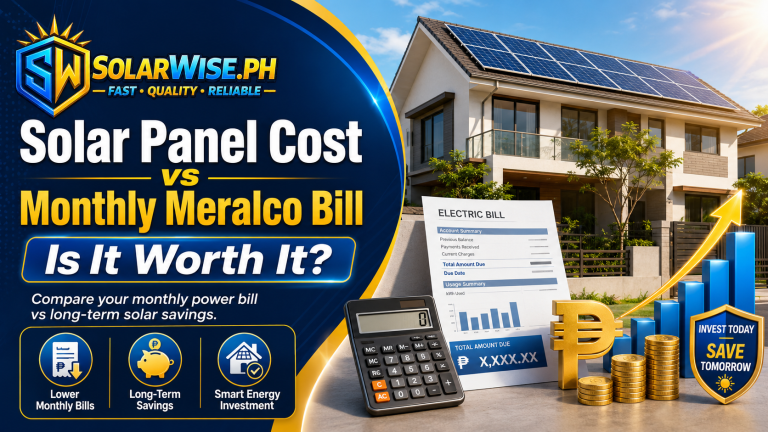
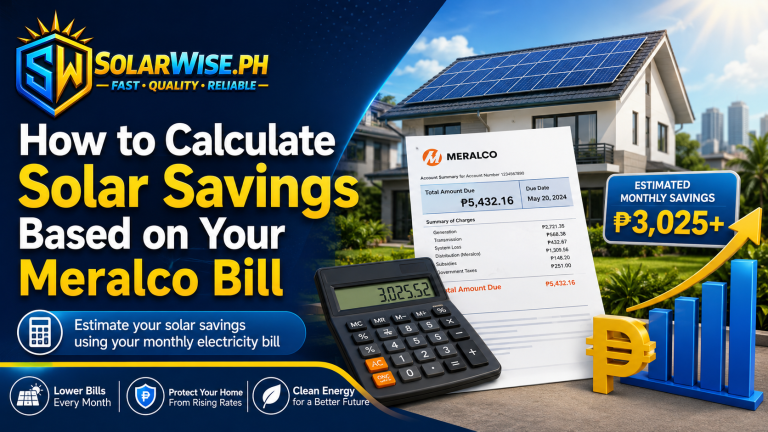
The first step is to review your monthly electric bill. Your bill helps estimate your electricity usage and possible solar system size.
Prepare your latest bill and check:
- monthly bill amount,
- monthly kWh consumption,
- service address,
- account details,
- and usage pattern if available.
The peso amount is helpful, but your kWh consumption is more important because electricity rates can change. Your kWh usage shows how much electricity your home actually consumes.
Step 2: Solar Consultation
After checking your electric bill, the next step is consultation. During this stage, SolarWise PH can help you understand:
- possible system size,
- estimated number of solar panels,
- system type recommendation,
- expected savings,
- roof requirements,
- possible net metering option,
- and estimated installation budget.
This is where you can ask questions such as:
- How many solar panels do I need?
- Can solar reduce my Meralco bill?
- Do I need batteries?
- Is my roof suitable for solar?
- How long is the installation process?
Step 3: Site Assessment
A proper site assessment is important before finalizing the solar design.
During a site assessment, the installer checks:
- roof size,
- roof material,
- roof angle,
- roof direction,
- shading from trees or buildings,
- structural condition,
- electrical panel,
- wire route,
- inverter location,
- and installation access.
This step helps avoid wrong sizing, poor performance, and installation issues.
Step 4: System Design and Quotation
After the assessment, the solar provider prepares a recommended system design and quotation.
A good solar quotation should include:
- system size in kW,
- number of panels,
- panel wattage,
- inverter brand and capacity,
- system type,
- estimated production,
- installation scope,
- warranty details,
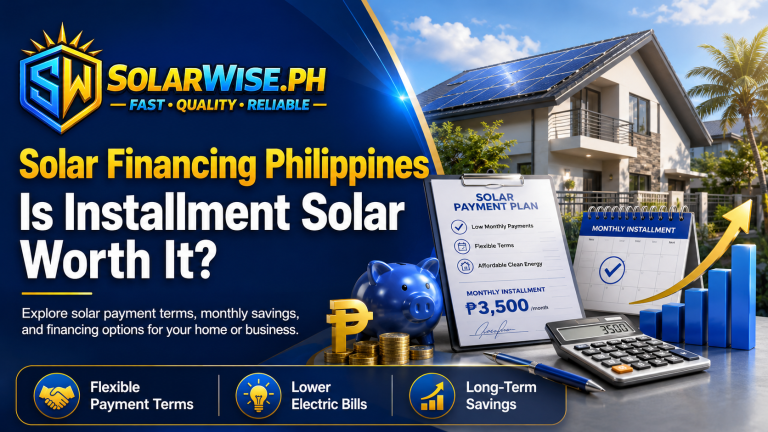
- payment terms,
- and exclusions, if any.
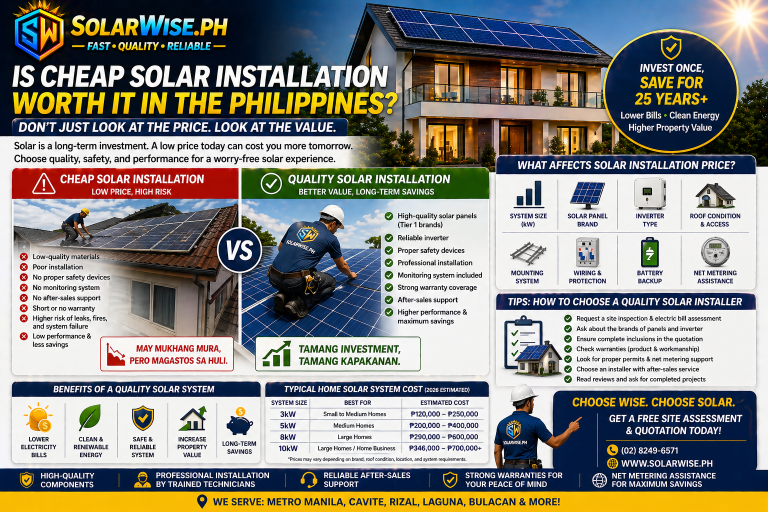
Do not choose based only on the cheapest price. Solar is a long-term investment, so quality of equipment, workmanship, safety, and after-sales support matter.
Step 5: Installation
Once the quotation is approved, the installation team will schedule the work.
The installation may include:
- mounting structure setup,
- solar panel installation,
- inverter installation,
- DC and AC wiring,
- electrical protection installation,
- system testing,
- and commissioning.
Installation time depends on the system size and project complexity. Small residential systems may be completed faster, while larger or more complex installations may take longer.
Step 6: Testing and Commissioning
After installation, the system must be checked and tested.
This includes checking:
- panel output,
- inverter operation,
- wiring safety,
- protection devices,
- monitoring app,
- and overall system performance.
This step ensures that the solar system is working safely and properly before regular use.
Step 7: Net Metering Application, If Applicable
If your home is eligible, you may apply for net metering.
Meralco describes net metering as a program under the Renewable Energy Act where eligible customers may install a renewable energy facility up to 100 kW and export excess renewable energy to the grid, with the corresponding value credited to the next bill.
The Department of Energy also explains net metering as a scheme that allows electricity end-users to generate renewable electricity primarily for their own use and sell unused electricity to the grid.
In simple terms, net metering can help you maximize solar savings when your solar panels produce more electricity than your home uses during the day.
What Is Net Metering?
Net metering allows eligible solar customers to export excess solar energy to the grid and receive credits on their electric bill.
Example:
- Your solar panels produce electricity during the day.
- Your home uses the solar power first.
- If your system produces extra electricity, it may be exported to the grid.
- The exported electricity can become credits on your next bill.
Net metering is useful for homes that produce more solar power than they consume during some parts of the day.
For Meralco customers, this can be helpful in areas such as Metro Manila, Cavite, Quezon City, Rizal, South Metro Manila, Las Piñas, Muntinlupa, Parañaque, Bacoor, Imus, Antipolo, Cainta, and Taytay.
The Energy Regulatory Commission also updated net-metering rules in 2025 to make adoption easier for end-users, according to public reports on the ERC amendments.
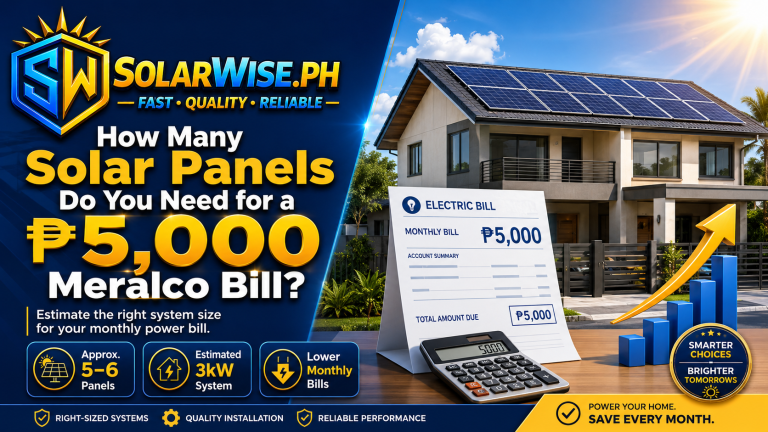
How Many Solar Panels Do You Need for Your Home?
The number of solar panels you need depends on your electricity usage and system size.
As a quick estimate:
| Monthly Electric Bill | Possible System Size | Estimated Panel Count |
|---|---|---|
| ₱5,000/month | Around 3kW | 5–6 panels |
| ₱10,000/month | Around 5kW | 9–10 panels |
| ₱15,000/month | Around 8kW | 14–15 panels |
These estimates depend on panel wattage, roof space, shading, and actual electricity consumption.
For example, a home with a ₱10,000 monthly bill may not automatically need the same system as another home with the same bill. One home may use more electricity during daytime, while another may use more electricity at night.
That is why a proper solar assessment is important.
How Much Roof Space Do You Need?
Solar panels need enough usable roof space. The exact space depends on the size and wattage of the panels.
As a simple guide:
| System Size | Estimated Number of Panels | Approximate Roof Space |
|---|---|---|
| 3kW | 5–6 panels | Around 12–16 sqm |
| 5kW | 9–10 panels | Around 22–28 sqm |
| 8kW | 14–15 panels | Around 35–45 sqm |
| 10kW | 18–20 panels | Around 45–55 sqm |
Your roof should ideally have:
- minimal shading,
- good sun exposure,
- enough open space,
- safe access,
- strong structure,
- and proper orientation.
If your roof has trees, nearby buildings, water tanks, antennas, or other obstructions, your installer should check how these may affect solar production.
How Much Does Solar Panel Installation Cost in the Philippines?
Solar panel installation cost in the Philippines depends on:
- system size,
- solar panel brand,
- inverter brand,
- grid-tied or hybrid setup,
- roof condition,
- installation complexity,
- electrical upgrades,
- monitoring system,
- net metering support,
- and battery requirements.
In general, smaller grid-tied systems cost less, while hybrid systems with batteries cost more.
Instead of asking only, “Magkano ang solar panels?”, it is better to ask:
“What system size is right for my home, and how much can it reduce my bill?”
A properly sized system is more important than simply buying the cheapest package.
What Documents or Information Do You Need?
Before requesting a solar assessment, prepare these:
- latest electric bill,
- monthly kWh consumption,
- complete address or service area,
- roof photos, if available,
- number of floors,
- typical appliance usage,
- daytime electricity usage,
- and whether you want battery backup.
This information helps SolarWise PH recommend the right system size for your property.
Benefits of Solar Panel Installation for Homeowners
Lower Monthly Electric Bills
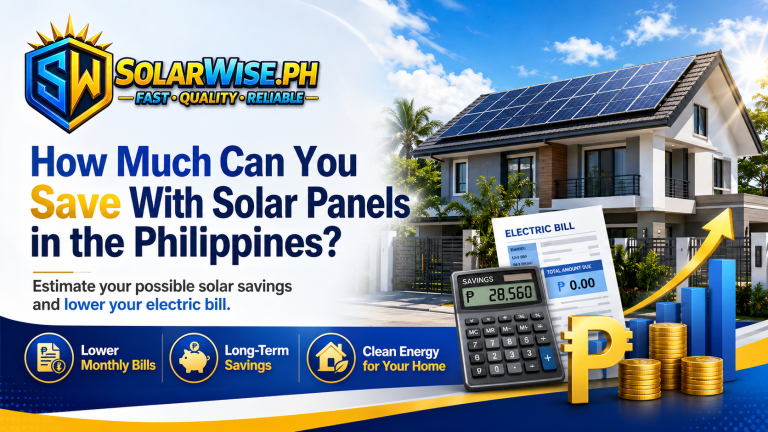
The biggest reason homeowners install solar panels is to reduce electricity costs. A properly designed solar system can help power your home during the day and reduce the electricity you buy from the grid.
Protection From Rising Electricity Costs
Solar helps reduce your dependence on utility electricity. This gives you more control over your long-term energy expenses.
Clean and Renewable Energy
Solar power uses sunlight, which is a renewable energy source. It helps reduce your household’s reliance on traditional energy sources.
Better Property Value
A well-installed solar system can make a home more attractive to buyers who are interested in lower electricity costs and energy efficiency.
Long-Term Investment
Solar is not just a home upgrade. It is a long-term investment that can provide savings over many years when properly designed and maintained.
Common Mistakes to Avoid Before Installing Solar Panels
Mistake #1: Choosing the Cheapest Quote
The cheapest quote is not always the best. Poor quality installation can lead to lower performance, safety issues, and higher repair costs later.
Mistake #2: Not Checking Roof Shading
Shading from trees, nearby buildings, and roof obstructions can reduce solar production. Always check shading before installation.
Mistake #3: Oversizing the System
A bigger system is not always better. If your system produces too much unused electricity and you do not have net metering, you may not maximize your savings.
Mistake #4: Ignoring Daytime Usage
Solar panels produce electricity during the day. If most of your usage happens at night, your installer should consider net metering or a hybrid system.
Mistake #5: Not Asking About Warranty and Support
Ask about warranties for panels, inverter, installation workmanship, and after-sales support.
Solar Panel Installation in Metro Manila, Cavite, QC, and Rizal
SolarWise PH can help homeowners and businesses explore solar solutions in key areas such as:
- Metro Manila,
- South Metro Manila,
- Las Piñas,
- Muntinlupa,
- Parañaque,
- Alabang,
- Cavite,
- Bacoor,
- Imus,
- Dasmariñas,
- General Trias,
- Quezon City,
- Rizal,
- Antipolo,
- Cainta,
- and Taytay.
If you are searching for solar panel installation near me, solar installer in Cavite, solar panels for home in Quezon City, or solar installation in Rizal, SolarWise PH can help assess your home and recommend a practical solar setup.
FAQs About Solar Panel Installation in the Philippines
How much is solar panel installation in the Philippines?
The cost depends on system size, equipment brand, installation complexity, and whether the system is grid-tied, hybrid, or off-grid. A site assessment is the best way to get an accurate quotation.
How many solar panels do I need for my home?
It depends on your monthly kWh consumption, electric bill, roof space, and daytime usage. As a rough estimate, a ₱5,000 bill may need around 5–6 panels, a ₱10,000 bill may need around 9–10 panels, and a ₱15,000 bill may need around 14–15 panels.
Is a grid-tied solar system enough?
For many homeowners, yes. A grid-tied system is usually the most cost-effective option if your main goal is to reduce your electric bill. If you want backup power during outages, a hybrid system may be better.
Do I need batteries for solar panels?
Not always. Batteries are useful for backup power, but they increase upfront cost. If your goal is bill reduction, a grid-tied system may be enough.
Can I apply for net metering?
You may apply for net metering if your system and property meet the requirements of your distribution utility. Under Meralco’s net metering program, eligible customers may install renewable energy facilities up to 100 kW and receive credits for excess exported electricity.
Can solar panels make my bill zero?
Solar can greatly reduce your electricity bill, but a zero bill is not guaranteed. Your final savings depend on system size, daytime usage, net metering, weather, roof condition, and appliance habits.
How long does solar panel installation take?
Installation time depends on system size and project complexity. A simple residential installation may be faster, while larger homes, complex roofs, or hybrid systems may take longer.
What areas does SolarWise PH serve?
SolarWise PH focuses on the Philippines, especially areas such as Metro Manila, South Metro Manila, Cavite, Quezon City, and Rizal.
Final Thoughts: Should You Install Solar Panels at Home?
Solar panel installation can be a smart investment for Filipino homeowners who want to lower electricity bills, use cleaner energy, and improve long-term energy security.
The key is to choose the right system size, not just the cheapest package. Your installer should check your electric bill, roof space, shading, daytime usage, and net metering options before recommending a system.
If you are planning to install solar panels in Metro Manila, Cavite, Quezon City, Rizal, or South Metro Manila, SolarWise PH can help you understand your options and design a system that fits your home.
Ready to start your solar journey?
Contact SolarWise PH today for a solar consultation and site assessment.
SolarWise PH — Fast. Quality. Reliable.