
Introduction
Solar Panel Price Philippines 2026: How Much Does Solar Installation Cost?
High electricity bills are one of the biggest reasons many Filipino homeowners and business owners are now considering solar power. Whether you are in Metro Manila, Cavite, Quezon City, Rizal, or nearby areas, installing solar panels can help reduce your monthly electricity cost and give you better control over your long-term energy expenses.
But before you invest, the first question is usually simple:
How much does solar panel installation cost in the Philippines in 2026?
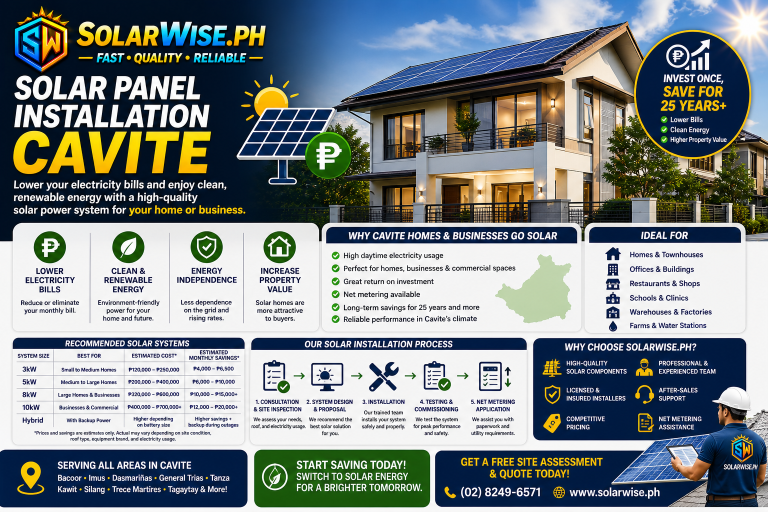
The short answer: a typical residential solar system in the Philippines can cost anywhere from around ₱180,000 to ₱650,000 or more, depending on the system size, equipment quality, roof condition, inverter type, battery requirement, and installation complexity. Recent local solar cost guides commonly place residential grid-tied solar at around ₱45,000 to ₱75,000 per kW installed, with 5kW systems often estimated around ₱275,000 to ₱375,000 depending on inclusions and site conditions.
At SolarWise PH, we always recommend a proper site assessment before giving a final quote because every home has different electricity usage, roof space, shading, wiring condition, and installation requirements.
How Much Do Solar Panels Cost in the Philippines in 2026?
Here is a practical estimate for common residential solar system sizes in the Philippines:
| System Size | Estimated Price Range | Best For |
|---|---|---|
| 3kW Solar System | ₱165,000 – ₱225,000 | Small homes, lower daytime usage |
| 5kW Solar System | ₱275,000 – ₱375,000 | Medium homes with moderate to high bills |
| 8kW Solar System | ₱440,000 – ₱600,000 | Larger homes, multiple aircon units |
| 10kW Solar System | ₱550,000 – ₱750,000 | High-consumption homes or small businesses |
| 15kW+ Solar System | ₱825,000+ | Businesses, large houses, commercial use |
These are estimated market ranges for grid-tied systems. Your actual solar installation cost may be higher or lower depending on your location, roof type, equipment brand, system design, and whether you need batteries or net metering support.
A 5kW on-grid solar system is one of the most common residential setups in the Philippines because it can support many homes with medium to high electricity consumption. Some 2026 Philippine solar guides estimate a 5kW installed system at around ₱275,000 to ₱375,000, while other local estimates place a typical 5kW system around ₱300,000 to ₱350,000 depending on the project.
What Is Included in Solar Panel Installation Cost?
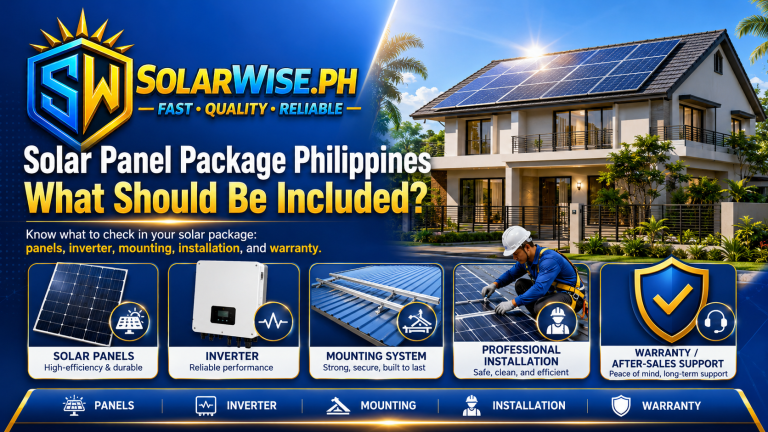
A complete solar installation is more than just the panels. A proper solar package may include:
- Solar panels
- Solar inverter
- Mounting structure
- Electrical wiring
- DC and AC protection
- Labor and installation
- System design
- Site inspection
- Testing and commissioning
- Monitoring setup, if available
- Net metering assistance, if applicable
This is why two homes with the same 5kW system size can still have different prices. A simple roof installation may cost less, while a more complex roof layout, long wire run, old electrical panel, or battery-ready setup may increase the final cost.
What Affects Solar Panel Price in the Philippines?
1. Your Monthly Electricity Bill
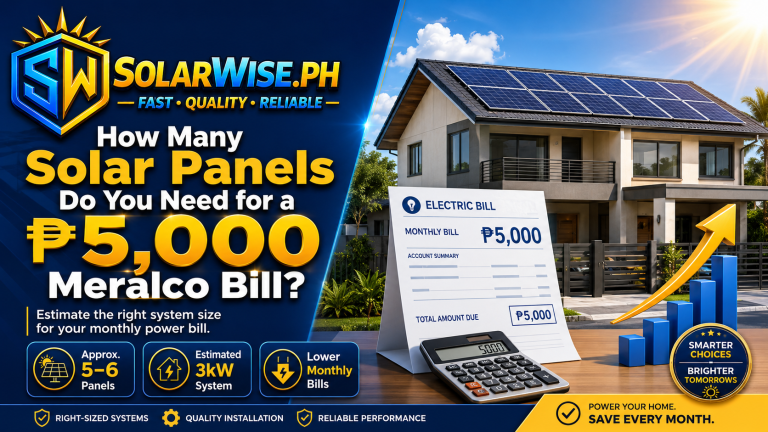
The higher your monthly electric bill, the bigger the solar system you may need. A home paying ₱5,000 per month will usually need a different system size compared to a home paying ₱15,000 or ₱20,000 per month.
As a general guide:
| Monthly Electric Bill | Possible Solar System Size |
|---|---|
| ₱4,000 – ₱6,000 | 3kW – 4kW |
| ₱7,000 – ₱10,000 | 5kW – 6kW |
| ₱11,000 – ₱15,000 | 7kW – 10kW |
| ₱16,000 – ₱25,000+ | 10kW – 15kW+ |
This is only a rough estimate. The best system size depends on your actual consumption pattern, especially how much electricity you use during daytime.
2. Daytime Electricity Usage
Solar panels produce power during the day. If your household uses air conditioning, appliances, computers, pumps, or business equipment during daytime, you can maximize your solar savings.
If most of your electricity use happens at night, you may need either:
- a smaller grid-tied system,
- net metering, or
- a hybrid system with batteries.
3. Grid-Tied vs Hybrid Solar System
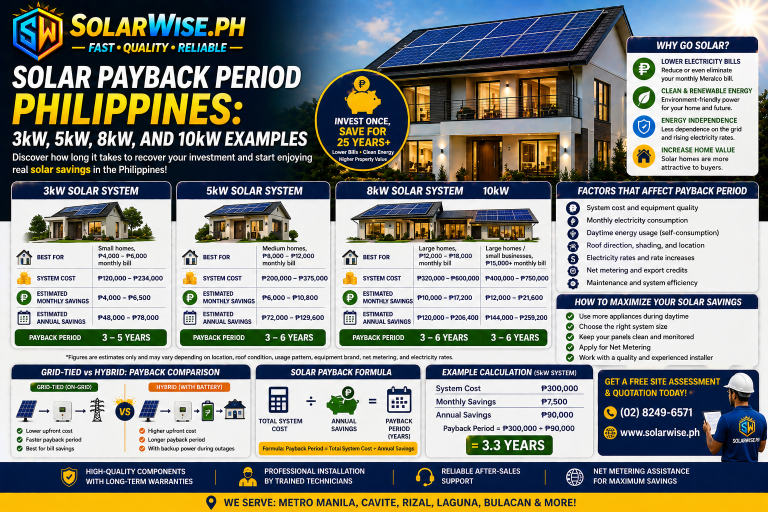
A grid-tied solar system is usually more affordable because it does not include batteries. It connects to your home and the utility grid. During the day, your solar panels help power your home and reduce the electricity you buy from the grid.
A hybrid solar system costs more because it includes batteries or battery-ready equipment. This is useful if you want backup power during outages or if you want to store excess solar energy for later use.
For many homes in Metro Manila, Cavite, QC, and Rizal, a grid-tied system is often the most cost-effective starting point. But if your area experiences frequent power interruptions, a hybrid setup may be worth considering.
4. Roof Size, Direction, and Shading
Your roof condition can affect both cost and performance. Solar panels work best when there is enough unshaded roof space and good sun exposure.
Common roof factors include:
- available roof area,
- roof angle,
- roof material,
- direction of the roof,
- nearby trees or buildings,
- structural condition,
- access difficulty.
If your roof has heavy shading, your system may produce less energy. This is why SolarWise PH recommends a proper site assessment before finalizing the system design.
5. Equipment Brand and Quality
Not all solar panels and inverters are the same. Some brands cost more because they offer better efficiency, stronger warranty support, better monitoring, or better long-term reliability.
When comparing solar quotes, do not only look at the lowest price. Check the quality of:
- solar panels,
- inverter,
- mounting structure,
- electrical protection,
- workmanship,
- warranty,
- after-sales support.
A cheap solar system can become expensive later if it has poor installation quality or weak support.
Is Solar Worth It in the Philippines?
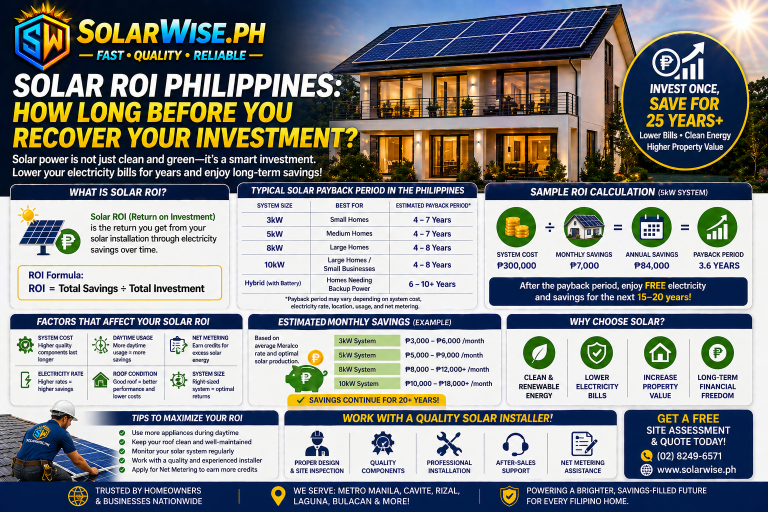
For many Filipino homeowners and businesses, solar can be worth it because electricity rates are high and the Philippines has strong sunlight for most of the year.
Solar is usually most beneficial if:
- your monthly bill is at least ₱5,000,
- you use electricity during daytime,
- your roof has good sun exposure,
- you plan to stay in the property long-term,
- you want to reduce dependence on rising electricity costs.
Homes and businesses in South Metro Manila, Cavite, Quezon City, and Rizal can be good candidates for solar, especially if they have high daytime usage from air conditioners, appliances, computers, pumps, refrigeration, or office equipment.
Can Net Metering Lower Your Electric Bill?
Yes, net metering can help improve your solar savings if your system exports excess electricity to the grid.
Meralco explains net metering as a program under the Renewable Energy Act where eligible customers may install a renewable energy facility up to 100kW and export excess electricity, with the corresponding value credited to the next bill.
In simple terms:
- Your solar panels produce electricity during the day.
- Your home uses solar power first.
- If your system produces more than you use, the excess can be exported to the grid.
- The exported electricity may become credits on your bill.
Meralco also notes that approved net metering installations require proper inspection, testing, commissioning, and installation of a bi-directional meter before the system can safely operate under the net metering setup.
SolarWise PH can help guide you through the process and explain whether net metering makes sense for your property.
Sample Solar Cost Scenario
Let’s say your household pays around ₱8,000 to ₱12,000 per month for electricity.
A possible recommendation may be around a 5kW to 6kW grid-tied solar system, depending on your actual usage pattern and roof space. Based on common 2026 market estimates, a 5kW system may fall around ₱275,000 to ₱375,000 installed.
However, this does not mean every 5kW system will have the same price. The final quote depends on:
- your roof layout,
- panel brand,
- inverter brand,
- installation difficulty,
- wiring distance,
- electrical upgrades,
- net metering requirements,
- whether the system is battery-ready.
That is why a proper consultation and site assessment is important.
Grid-Tied or Hybrid: Which One Should You Choose?
Choose a grid-tied solar system if your main goal is to lower your electric bill and you do not need battery backup. This is usually the more affordable option.
Choose a hybrid solar system if you want backup power during outages or want to store solar energy for evening use. This costs more upfront but may be useful for homes or businesses that need more energy security.
For most first-time solar customers, the best approach is to start with this question:
Do you want maximum savings, backup power, or both?
Your answer will help determine the right system type.
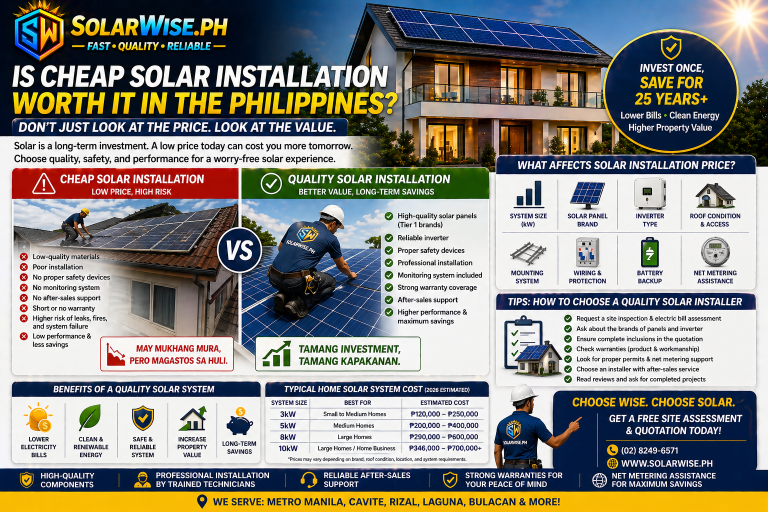
Why You Should Not Choose Based on Price Alone
When comparing solar companies, it is tempting to pick the cheapest quote. But solar is a long-term investment. Your system should last for many years, so quality matters.
Before choosing a solar installer, ask:
- What solar panel brand will be used?
- What inverter brand is included?
- Is the system properly sized?
- Is the roof structure checked?
- Are permits and net metering included?
- What warranties are provided?
- Is there after-sales support?
- Are the installers experienced?
- Is the quotation transparent?
A reliable solar installation should be safe, properly designed, and built for long-term performance.
Solar Panel Installation in Metro Manila, Cavite, QC, and Rizal
SolarWise PH serves homeowners and businesses in the Philippines, especially in areas such as:
- South Metro Manila
- Las Piñas
- Muntinlupa
- Parañaque
- Alabang
- Cavite
- Bacoor
- Imus
- Dasmariñas
- Quezon City
- Rizal
- Antipolo
- Cainta
- Taytay
Whether you need solar for your home, office, commercial building, or small business, SolarWise PH can help you estimate the right system size and understand your potential savings.
Frequently Asked Questions
How much is solar panel installation in the Philippines in 2026?
Residential solar installation in the Philippines can range from around ₱180,000 to ₱650,000 or more, depending on system size and project requirements. A common 5kW grid-tied system may cost around ₱275,000 to ₱375,000 based on recent Philippine solar market estimates.
What is the best solar system size for a home?
It depends on your monthly electricity bill, daytime usage, and roof space. Many medium-sized homes consider around 5kW, while larger homes or small businesses may need 8kW to 15kW or more.
Can solar panels eliminate my electric bill?
Solar can significantly reduce your bill, but whether it can eliminate it depends on your system size, energy usage, net metering, and how much electricity you consume at night.
Do I need batteries for my solar system?
Not always. If your main goal is lower electricity bills, a grid-tied system may be enough. If you want backup power during outages, a hybrid system with batteries may be better.
Is net metering available in the Philippines?
Yes. Net metering is available for eligible renewable energy systems up to 100kW, and excess electricity exported to the grid can be credited to the customer’s bill under the program.
Does SolarWise PH offer free consultation?
Yes. SolarWise PH can help assess your electricity usage, location, roof condition, and possible system size so you can understand your estimated cost and savings before deciding.
Final Thoughts: How Much Should You Budget for Solar in 2026?
If you are planning to install solar panels in the Philippines in 2026, a good starting budget is around:
- ₱180,000 to ₱250,000 for smaller homes,
- ₱275,000 to ₱375,000 for common 5kW home systems,
- ₱500,000+ for larger homes or small businesses,
- higher if you need batteries or a hybrid system.
But the best way to know your actual solar panel price is to get a proper assessment.
Ready to find out how much solar installation will cost for your home or business?
Contact SolarWise PH today for a solar consultation and site assessment. We’ll help you estimate your system size, installation cost, savings potential, and the best solar setup for your property.
SolarWise PH — Fast. Quality. Reliable.