
Grid-Tied vs Hybrid Solar System: Which Is Better for Homes in the Philippines?
Planning to install solar panels at home but not sure whether to choose a grid-tied solar system or a hybrid solar system?
You are not alone. Many Filipino homeowners ask the same question before investing in solar:
“Mas okay ba ang grid-tied solar or hybrid solar for my home?”
The best answer depends on your goal. If your main priority is to lower your monthly electric bill, a grid-tied solar system is usually the more practical and cost-effective choice. But if you want backup power during brownouts, a hybrid solar system may be better because it can work with batteries.
For homeowners in Metro Manila, Cavite, Quezon City, Rizal, South Metro Manila, Las Piñas, Muntinlupa, Parañaque, Bacoor, Imus, Dasmariñas, Antipolo, Cainta, and Taytay, choosing the right solar setup depends on your Meralco bill, daytime usage, roof space, budget, and need for backup power.
This guide will explain the difference between grid-tied and hybrid solar systems so you can choose the right setup for your home.
What Is a Grid-Tied Solar System?
A grid-tied solar system is a solar power setup connected to your home and to the electric grid.
During the day, your solar panels generate electricity from sunlight. Your home uses that solar power first. If your appliances need more electricity than your solar system can produce, the remaining power comes from the grid.
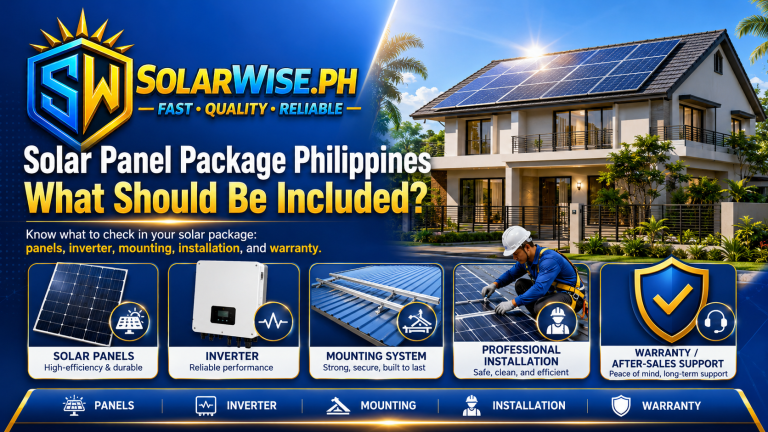
A grid-tied system usually includes:
- solar panels,
- grid-tied inverter,
- mounting structure,
- DC and AC wiring,
- protection devices,
- monitoring system, if available,
- and net metering setup, if applicable.
This type of system is popular because it is usually more affordable than a hybrid system. It does not require batteries, so the upfront cost is lower.
For many homes in the Philippines, especially those with daytime electricity usage, grid-tied solar is often the best starting point.
What Is a Hybrid Solar System?
A hybrid solar system is a solar setup that combines solar panels, grid connection, and battery storage.
Like a grid-tied system, it can power your home during the day using solar energy. But unlike a basic grid-tied setup, a hybrid system can store energy in batteries. This stored energy may be used later, depending on the system design.
A hybrid system usually includes:
- solar panels,
- hybrid inverter,
- battery storage,
- mounting structure,
- DC and AC wiring,
- protection devices,
- backup load panel, if required,
- monitoring system,
- and net metering option, if applicable.
The main advantage of a hybrid solar system is backup power. If there is a power interruption, selected appliances can continue running using the battery, depending on the battery size and system configuration.
This is useful for homes that need backup power for:
- WiFi router,
- lights,
- refrigerator,
- CCTV,
- computers,
- medical equipment,
- selected outlets,
- and other important appliances.
Grid-Tied vs Hybrid Solar System: Main Difference
The biggest difference is simple:
Grid-tied solar helps reduce your electric bill. Hybrid solar helps reduce your electric bill and can provide backup power, depending on the battery setup.
Here is a simple comparison:
| Feature | Grid-Tied Solar System | Hybrid Solar System |
|---|---|---|
| Main purpose | Lower electric bill | Lower bill + backup power |
| Battery required | No | Yes, or battery-ready |
| Upfront cost | Lower | Higher |
| Works during brownout | Usually no | Yes, for selected loads if designed with backup |
| Best for | Bill reduction | Bill reduction + energy security |
| Maintenance | Simpler | More components to maintain |
| Ideal user | Homeowners focused on ROI | Homeowners who need backup power |
| Net metering | Commonly used | Possible, depending on design |
Which Solar System Is Better for Homes in the Philippines?
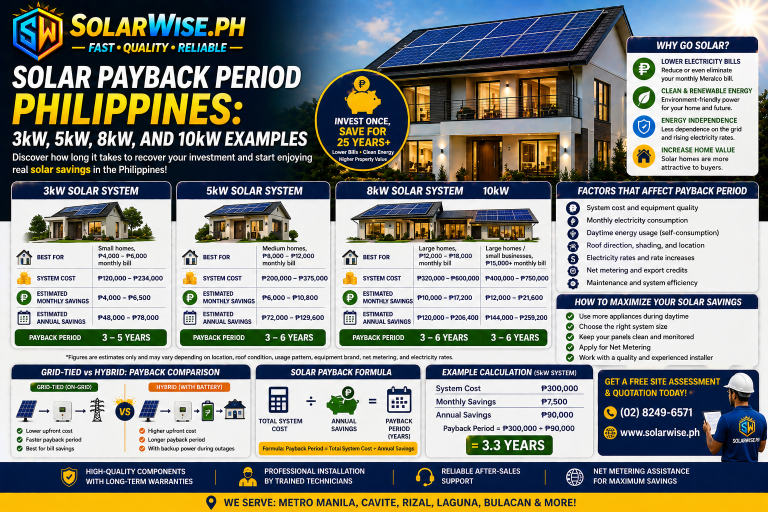
For many homeowners, a grid-tied solar system is better if the goal is to lower the monthly electric bill at the lowest practical upfront cost.
A hybrid solar system is better if you want backup power and are willing to invest more because of batteries and additional equipment.
In simple terms:
Choose hybrid solar if you want lower electric bills plus backup power during outages.
The right choice depends on your household’s needs, not just the system price.
When Should You Choose Grid-Tied Solar?
A grid-tied solar system may be the best choice if your main goal is savings.
Choose grid-tied solar if:
- you want to reduce your monthly Meralco bill,
- you want a lower upfront cost,
- you do not need battery backup,
- your area has reliable power supply,
- your home uses electricity during daytime,
- you want a faster return on investment,
- and you are interested in net metering.
This is often recommended for homeowners in Metro Manila, Cavite, Quezon City, Rizal, and South Metro Manila who have high daytime usage from air conditioning, refrigerators, computers, water pumps, and appliances.
When Should You Choose Hybrid Solar?
A hybrid solar system may be better if you want backup power and more energy security.
Choose hybrid solar if:
- your area has frequent brownouts,
- you need backup power for important appliances,
- you work from home and need stable electricity,
- you have medical or security equipment,
- you want to store solar energy,
- you are willing to invest more upfront,
- and you want a more flexible solar setup.
Hybrid solar is useful for homes that cannot afford sudden power interruptions, especially if you need to keep essential appliances running.
Is Grid-Tied Solar Cheaper Than Hybrid Solar?
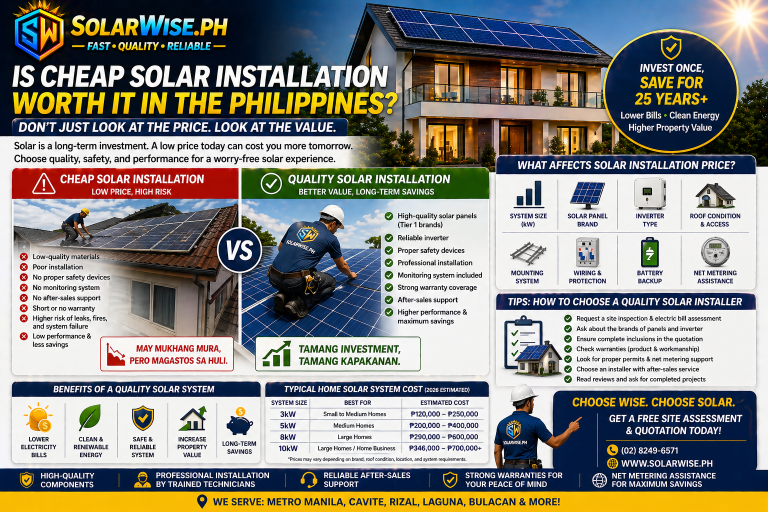
Yes, grid-tied solar is usually cheaper than hybrid solar because it does not require batteries.
Batteries are one of the most expensive parts of a hybrid system. Aside from the battery itself, a hybrid setup may also require a hybrid inverter, backup load design, additional protection devices, and more complex installation work.
That is why homeowners focused mainly on reducing electric bills often start with grid-tied solar.
Hybrid solar costs more, but it provides an important benefit: backup power.
Can Grid-Tied Solar Work During a Brownout?
In most standard grid-tied setups, the system shuts down during a power outage for safety reasons. This prevents electricity from flowing back to the grid while utility workers may be repairing the line.
That means if you have a regular grid-tied system without battery backup, your solar system usually will not power your home during a brownout.
If backup power is important to you, ask SolarWise PH about a hybrid solar system or backup-ready solar design.
Can Hybrid Solar Work During a Brownout?
Yes, a properly designed hybrid solar system can provide backup power during a power interruption.
However, it is important to understand that not all appliances may be included in the backup. Usually, the system is designed to support selected loads only, such as:
- lights,
- refrigerator,
- WiFi router,
- CCTV,
- laptop or computer,
- fans,
- selected outlets.
Heavy appliances like multiple air conditioners, electric ovens, electric showers, or large pumps may require a bigger battery and inverter setup.
This is why load planning is important before installing a hybrid solar system.
What Is Net Metering and Why Does It Matter?
Net metering can help homeowners maximize the value of a solar system, especially for grid-tied setups.
Meralco describes net metering as a program under Republic Act 9513 where eligible customers may install a renewable energy facility up to 100 kW at their property. Any excess renewable energy exported to Meralco is given as credits on the customer’s next bill.
The Department of Energy explains net metering as a scheme that allows electricity end-users to generate renewable electricity primarily for their own use and sell unused electricity to the grid.
In simple terms:
- Your solar panels generate electricity during the day.
- Your home uses solar power first.
- If your system produces more than your home uses, excess energy can be exported to the grid.
- The exported energy may become credits on your electric bill.
For Meralco customers, the process may include approval, interconnection testing, commissioning, and installation of a bi-directional meter before the solar net-metering setup is energized.
Is Net Metering for Grid-Tied or Hybrid Solar?
Net metering is commonly associated with grid-tied solar systems because they are directly connected to the grid and designed to export excess solar energy.
Hybrid systems may also be designed with net metering, depending on the inverter, battery setup, system configuration, and utility requirements.
Before choosing a system, it is important to ask:
Will it export excess energy?
Will it have zero-export settings?
Will it include battery backup?
What appliances will be supported during outages?
SolarWise PH can help explain which setup is more suitable for your home.
Grid-Tied Solar Pros and Cons
Advantages of Grid-Tied Solar
Lower Upfront Cost
Grid-tied systems are usually more affordable because they do not require batteries.
Good for Reducing Electric Bills
If your home uses electricity during the day, grid-tied solar can help reduce the power you buy from the grid.
Simpler System Design
With fewer components than hybrid systems, grid-tied solar is usually simpler to install and maintain.
Good Option for Net Metering
Grid-tied systems are commonly used with net metering, allowing eligible customers to export excess solar power and receive bill credits.
Faster Return on Investment
Because the upfront cost is lower, grid-tied systems often have a faster payback period compared to battery-based systems.
Disadvantages of Grid-Tied Solar
No Backup Power During Brownouts
A standard grid-tied system usually shuts down during power outages.
Dependent on the Grid
Your home still depends on the utility grid when solar production is low, such as at night or during cloudy weather.
Savings Depend on Daytime Usage
You get the most benefit when your home uses electricity while the sun is producing power.
Hybrid Solar Pros and Cons
Advantages of Hybrid Solar
Backup Power During Outages
Hybrid solar can power selected appliances during brownouts if properly designed with batteries.
More Energy Security
You have more control because some solar energy can be stored instead of being used only when the sun is up.
Useful for Work-From-Home Setups
Hybrid systems are helpful if you need stable power for internet, computers, security systems, or essential appliances.
Better for Areas With Frequent Brownouts
If your area experiences frequent power interruptions, hybrid solar may be worth the higher upfront cost.
Flexible System Design
A hybrid system can be designed for savings, backup, or both.
Disadvantages of Hybrid Solar
Higher Upfront Cost
Batteries and hybrid inverters make the system more expensive.
More Complex Design
Hybrid systems require careful load planning, battery sizing, backup circuit design, and proper configuration.
Battery Maintenance and Replacement
Batteries may need monitoring and eventual replacement depending on the type, usage, and warranty.
Not Always Needed
If your area rarely has brownouts and your main goal is bill reduction, a grid-tied system may be more practical.
Which System Has Better ROI?
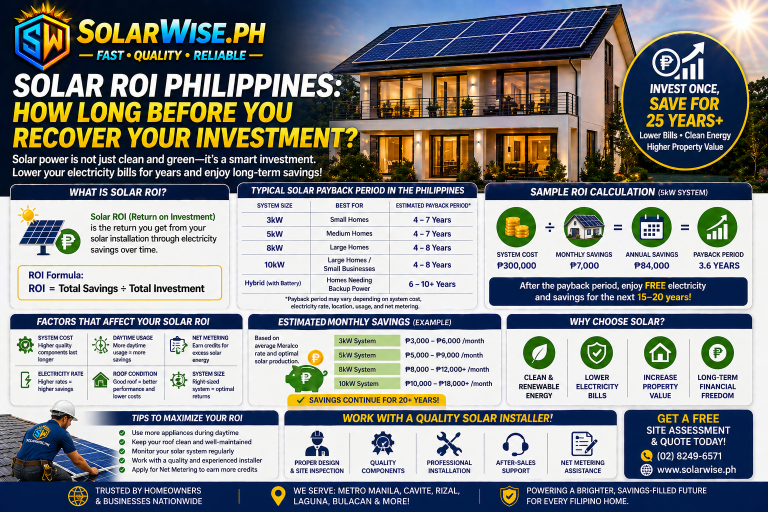
For many homeowners, grid-tied solar usually has better ROI because the upfront cost is lower and the system directly reduces daytime electricity usage.
Hybrid solar can still be worth it, but the value is not only about ROI. It also gives backup power and peace of mind.
Think of it this way:
Hybrid solar = best for savings plus backup power.
If you are only comparing pesos saved versus cost, grid-tied solar often wins. But if power reliability is important to your family or business, hybrid solar may be the better overall choice.
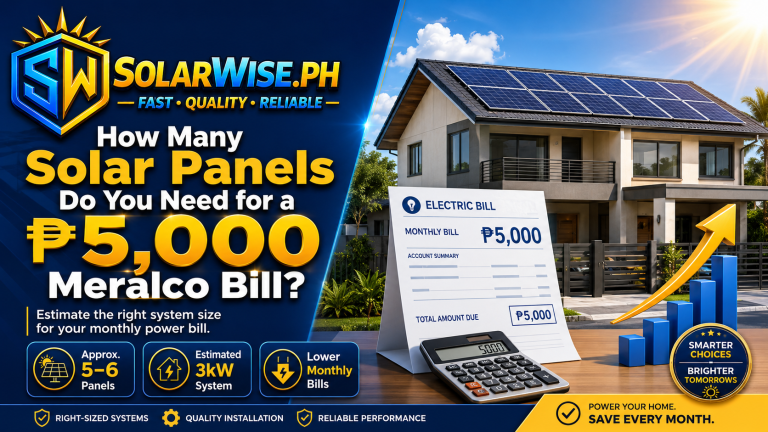
Which System Is Better for a ₱5,000, ₱10,000, or ₱15,000 Meralco Bill?
Here is a simple guide:
| Monthly Meralco Bill | Better Starting Option | Why |
|---|---|---|
| ₱5,000/month | Grid-tied solar | Lower cost, practical bill reduction |
| ₱10,000/month | Grid-tied or hybrid | Depends on need for backup power |
| ₱15,000/month | Grid-tied or hybrid | Higher usage may justify larger setup or backup |
| ₱20,000+/month | Custom design | May need detailed load study and net metering review |
A ₱10,000 or ₱15,000 monthly bill does not automatically mean hybrid is required. The question is whether you need backup power.
If you only want to reduce your electric bill, grid-tied solar may be enough. If you want to keep selected appliances running during brownouts, hybrid solar is worth considering.
Local Solar Recommendations by Area
Metro Manila
For homes in Metro Manila with high Meralco bills and reliable grid supply, grid-tied solar is usually a practical option. Hybrid solar may be recommended for homeowners who work from home or need backup power.
South Metro Manila
Homes in Las Piñas, Muntinlupa, Parañaque, and Alabang may benefit from either grid-tied or hybrid solar depending on roof space, daytime usage, and backup needs.
Cavite
For homeowners in Bacoor, Imus, Dasmariñas, and General Trias, solar can be a good investment if the roof has strong sunlight exposure. Grid-tied solar may be enough for bill savings, while hybrid solar is useful for backup power.
Quezon City
Homes in Quezon City often have high electricity usage due to air conditioning and work-from-home setups. Grid-tied solar can reduce bills, while hybrid solar can help keep internet, lights, and essential appliances running during outages.
Rizal
For homeowners in Antipolo, Cainta, Taytay, and nearby Rizal areas, the best system depends on roof shading, daytime usage, and whether backup power is needed.
How to Choose the Right Solar System for Your Home
Before deciding between grid-tied and hybrid solar, ask these questions:
- What is your monthly electric bill?
- How much electricity do you use during daytime?
- Do you experience frequent brownouts?
- Do you need backup power?
- Which appliances need to run during outages?
- Do you have enough roof space?
- Is your roof shaded?
- Are you interested in net metering?
- What is your budget?
- Do you want the fastest ROI or more energy security?
Your answers will help determine the right solar system design.
Recommended Setup Based on Your Goal
| Your Goal | Recommended System |
|---|---|
| Lower monthly bill only | Grid-tied solar |
| Lower bill with lower upfront cost | Grid-tied solar |
| Backup power during brownouts | Hybrid solar |
| Power for WiFi, lights, refrigerator during outage | Hybrid solar |
| Maximum ROI | Usually grid-tied solar |
| Energy security and comfort | Hybrid solar |
| Remote area without grid | Off-grid solar |
What SolarWise PH Recommends
At SolarWise PH, we do not recommend the same system for everyone. The right solar setup depends on your bill, roof, location, power usage, and budget.
For many homeowners, we usually start by checking whether a grid-tied solar system can already meet the main goal of reducing the electric bill.
But if the customer needs backup power, we can also assess a hybrid solar system with batteries and selected backup loads.
The goal is to recommend the solar system that fits your actual needs, not just the most expensive package.
FAQs About Grid-Tied vs Hybrid Solar Systems
What is better, grid-tied or hybrid solar?
Grid-tied solar is usually better if your main goal is to lower your electric bill at a lower upfront cost. Hybrid solar is better if you also want backup power during brownouts.
Is hybrid solar worth it in the Philippines?
Hybrid solar can be worth it if your area has frequent power interruptions or if you need backup power for important appliances. If your goal is only bill savings, grid-tied solar may be more practical.
Can grid-tied solar work without Meralco?
No. A grid-tied solar system is connected to the grid. If the grid is down, a standard grid-tied system usually shuts down for safety.
Can hybrid solar work during brownouts?
Yes, if properly designed with batteries and backup circuits. However, it usually powers selected appliances only, depending on inverter and battery capacity.
Do I need batteries for solar panels?
Not always. Batteries are optional if your goal is bill reduction. Batteries are useful if you want backup power or stored solar energy.
Can I use net metering with solar?
Yes, eligible customers may apply for net metering. Meralco says qualified customers can install renewable energy facilities up to 100 kW and receive credits for exported excess energy.
Which solar system is best for homes in Cavite, QC, Rizal, and Metro Manila?
For many homes in these areas, grid-tied solar is a practical starting point for bill savings. Hybrid solar is better if backup power is important.
Is hybrid solar more expensive than grid-tied solar?
Yes. Hybrid systems are usually more expensive because they need batteries, hybrid inverters, and more detailed backup load planning.
Final Thoughts: Grid-Tied or Hybrid Solar?
Both grid-tied and hybrid solar systems can help Filipino homeowners reduce electricity costs. The best choice depends on what you need most.
Choose grid-tied solar if your priority is:
lower upfront cost,
faster ROI,
and net metering compatibility.
Choose hybrid solar if your priority is:
battery storage,
energy security,
and power during brownouts.
For most homeowners in Metro Manila, Cavite, Quezon City, Rizal, and South Metro Manila, a properly designed grid-tied system is usually the best starting point. But for homes that need backup power, a hybrid solar system may be the smarter long-term choice.
Ready to know which solar system is right for your home?
Contact SolarWise PH today for a solar consultation and site assessment.
SolarWise PH — Fast. Quality. Reliable.