
On-Grid Solar System Philippines: Pros, Cons, and Best Use Cases
Kung gusto mong magpa-solar para bumaba ang monthly electric bill mo, one of the most practical options today is an on grid solar system Philippines setup. Also known as a grid-tied solar system, this type of solar power system is connected to both your property and the utility grid.
For many homeowners and business owners in the Philippines, especially in Metro Manila, Cavite, Rizal, Laguna, Bulacan, and nearby areas, on-grid solar is usually the most cost-effective solar setup. It allows your home or business to use solar energy during the day while still staying connected to the grid for power at night or when solar production is low.
But like any investment, an on-grid solar system has pros, cons, and ideal use cases. This guide will help you understand how it works, how much it may cost, when it is best to use, and whether it is the right solar setup for your property.
What Is an On-Grid Solar System?
An on-grid solar system Philippines setup is a solar power system connected to the utility grid. It uses solar panels to generate electricity from sunlight during the day. Your property uses that solar power first. If your solar panels produce less than what your home or business needs, the remaining electricity automatically comes from the grid.
If your solar panels produce more electricity than you are using and your system is approved for net metering, the excess power can be exported to the grid and converted into bill credits.
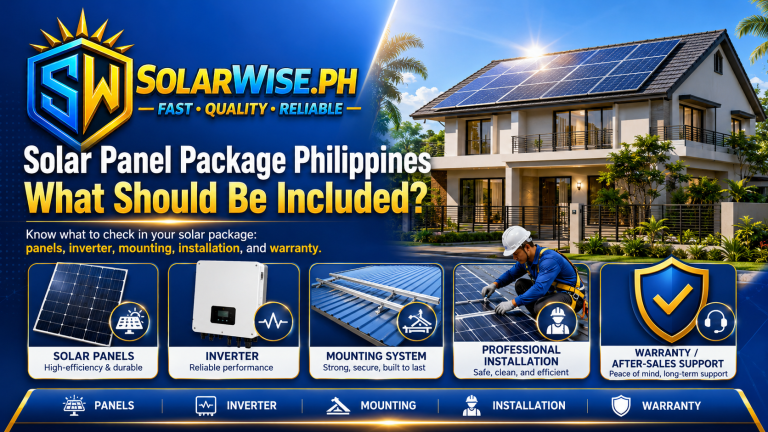
An on-grid solar system usually includes:
Solar panels
Grid-tied inverter
Mounting structure
DC and AC wiring
Breakers and protection devices
Grounding system
Monitoring system
Optional net metering application support
Bi-directional meter after utility approval
This setup is different from off-grid solar because it does not rely mainly on batteries. It is also different from hybrid solar because a standard on-grid system usually does not include battery backup.
How Does an On-Grid Solar System Work?
An on-grid solar system works by producing electricity during daylight hours. The solar panels convert sunlight into DC electricity. The inverter converts that power into AC electricity that your home or business can use.
Here is the simple flow:
Solar panels generate electricity from sunlight
The inverter converts solar energy into usable electricity
Your home or business uses solar power first
If solar production is not enough, power comes from the grid
If solar production is more than your usage, excess energy may go to the grid through net metering
Your electricity bill may be reduced through solar savings and bill credits
This makes on-grid solar ideal for properties with daytime electricity usage.
On-Grid Solar and Net Metering in the Philippines
One of the biggest advantages of an on-grid solar system is that it can be paired with net metering.
Net metering allows qualified renewable energy systems to export excess electricity to the grid and receive corresponding bill credits. For Meralco customers, net metering applies to qualified renewable energy facilities up to 100 kW, with exported excess electricity credited to the next bill.
For homeowners and businesses, this means your unused solar energy may still provide value instead of going to waste.
Net metering is especially useful if:
Your solar system produces excess power during the day
Your home has lower daytime usage but strong solar production
Your system is properly sized
Your property is under a distribution utility that supports net metering
Your system uses compliant equipment
You complete the utility application process
Pros of an On-Grid Solar System
1. Lower Monthly Electricity Bills
The main benefit of an on-grid solar system is lower electricity costs. During the day, your property uses solar energy first, reducing the amount of electricity you buy from the grid.
For homes with aircon use, work-from-home setups, refrigerators, pumps, and daytime appliances, this can lead to noticeable monthly savings.
2. More Affordable Than Hybrid Solar
On-grid solar is usually more affordable than hybrid solar because it does not require batteries. Batteries are one of the most expensive parts of a solar setup.
If your main goal is bill reduction, on-grid solar is often the most practical and budget-friendly choice.
3. Ideal for Net Metering
On-grid systems can be designed for net metering, allowing excess solar energy to be exported to the grid for bill credits.
This helps maximize the value of your solar system, especially during hours when solar production is higher than your consumption.
4. Low Maintenance
Because on-grid solar systems usually do not include batteries, maintenance is simpler. Solar panels are durable, and the inverter and monitoring system are usually the main components that need regular checking.
Basic maintenance includes cleaning panels when needed, checking the inverter app, and scheduling inspections after strong storms or roof repairs.
5. Good Return on Investment
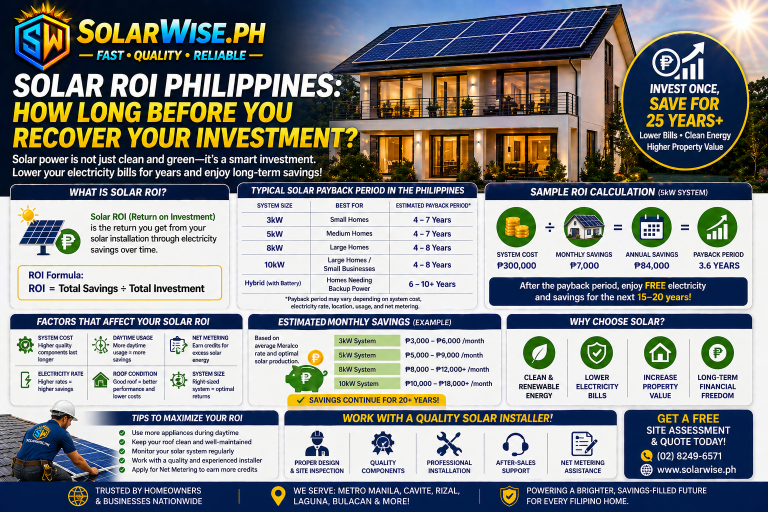
For properties with high electricity bills and good roof sunlight, an on-grid solar system can provide strong long-term value. The monthly savings can help recover the upfront installation cost over time.
6. Uses Clean and Renewable Energy
Solar power helps reduce dependence on grid electricity and fossil fuels. For homeowners and businesses that want a cleaner energy source, on-grid solar is a practical step toward sustainability.
7. Works Well for Homes and Businesses
On-grid solar is flexible and can be used for residential, commercial, office, school, clinic, restaurant, warehouse, and small business applications.
Cons of an On-Grid Solar System
1. No Power During Brownouts in Standard Setups
A standard on-grid solar system usually shuts down during power outages. This is a safety feature that prevents the system from sending power to the grid while utility workers may be repairing lines.
This means that even if the sun is shining, your on-grid system may not power your home during a blackout unless your setup includes special backup equipment or hybrid capability.
2. No Battery Storage
Standard on-grid systems do not store excess energy. Solar power is used during the day, exported to the grid if net-metered, or reduced depending on the system design.
If you want backup power at night or during outages, you may need a hybrid solar system with batteries.
3. Savings Depend on Daytime Usage
On-grid solar works best when your home or business uses electricity during the day. If most of your electricity consumption happens at night, your direct solar savings may be lower unless net metering helps offset some usage through credits.
4. Requires Utility Approval for Net Metering
Net metering is not automatic. You need to apply, submit documents, pass evaluation, and have the correct meter setup.
This process can take time and may require assistance from your solar installer.
5. Roof Shading Can Reduce Output
Trees, nearby buildings, antennas, water tanks, and roof obstructions can reduce solar production. Proper site inspection and system design are important before installation.
6. Not Ideal for Remote Areas Without Grid Access
Because on-grid solar depends on grid connection, it is not suitable for properties without reliable utility service. Remote farms, rest houses, and off-grid sites may need off-grid or hybrid solar instead.
Best Use Cases for On-Grid Solar in the Philippines
Homes with High Daytime Electricity Use
On-grid solar is excellent for homes that use electricity during the day. This includes households with work-from-home setups, aircon usage, refrigerators, washing machines, water pumps, CCTV, Wi-Fi, and kitchen appliances.
Homeowners with Monthly Bills Above ₱5,000
If your monthly electricity bill is consistently above ₱5,000, an on-grid solar system may be worth considering. Higher bills usually mean more opportunity for solar savings.
Businesses Operating During the Day
On-grid solar is ideal for businesses because many operate during peak sunlight hours. Examples include offices, clinics, restaurants, schools, laundries, water stations, warehouses, shops, and small factories.
Homes in Metro Manila, Cavite, and Rizal
Many properties in Metro Manila, Cavite, and Rizal are connected to the grid and have high electricity demand. These areas are good candidates for on-grid solar if the roof has enough sunlight and space.
Properties Planning to Apply for Net Metering
If you want to receive bill credits for excess solar power, on-grid solar with net metering is the right setup.
Homeowners Who Want Lower Cost Than Hybrid Solar
If you do not need backup batteries, on-grid solar gives you a more affordable entry point compared to hybrid systems.
When Is On-Grid Solar Not the Best Choice?
On-grid solar may not be the best choice if:
You need backup power during brownouts
Your property has no grid connection
Your roof is heavily shaded
Your electricity use is mostly at night
Your monthly bill is very low
You plan to move soon
You want full energy independence
In these cases, hybrid or off-grid solar may be more suitable depending on your goal.
Estimated Cost of On-Grid Solar System Philippines
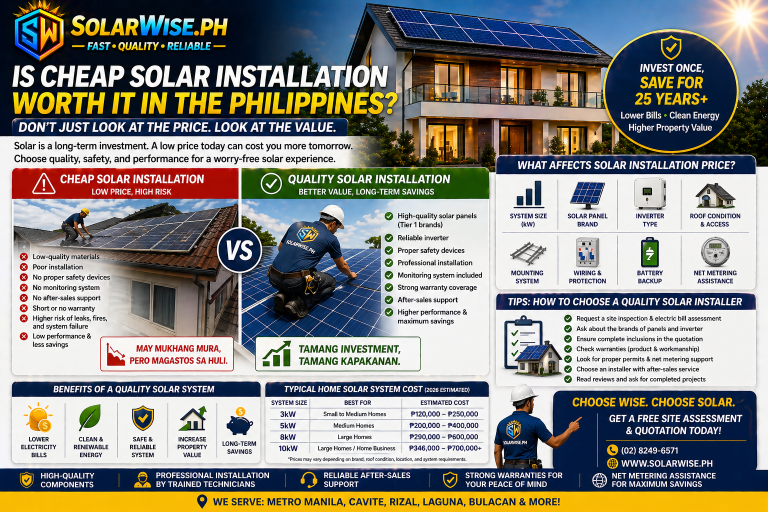
The cost of an on-grid solar system in the Philippines depends on system size, solar panel brand, inverter type, roof condition, wiring distance, installation complexity, and net metering support.
Here is a practical estimated guide:
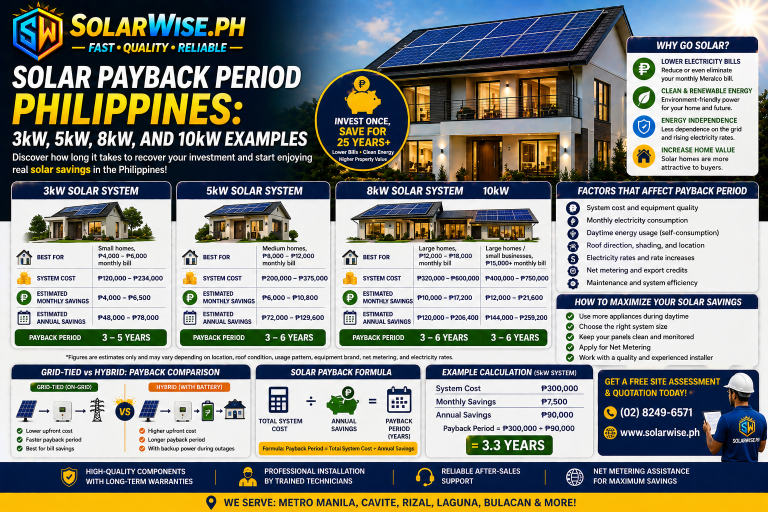
| On-Grid Solar Size | Best For | Estimated Cost Range |
|---|---|---|
| 2 kW | Small homes, low usage | ₱100,000 – ₱160,000 |
| 3 kW | Small to medium homes | ₱150,000 – ₱250,000 |
| 5 kW | Medium homes with aircon use | ₱250,000 – ₱400,000 |
| 7 kW | Large homes, higher usage | ₱350,000 – ₱500,000 |
| 10 kW | Large homes or small businesses | ₱450,000 – ₱700,000+ |
These are estimated price ranges only. The actual cost may vary based on equipment, roof structure, electrical setup, and installation requirements.
Recommended On-Grid Solar Size Based on Electric Bill
| Monthly Electric Bill | Suggested System Size |
|---|---|
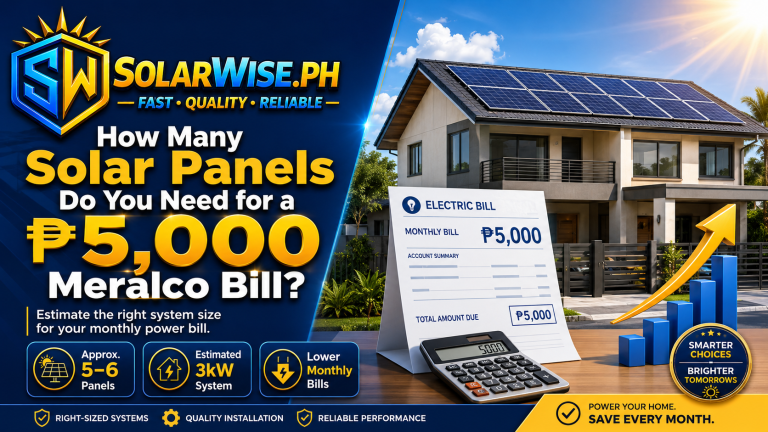
| ₱3,000 – ₱5,000 | 2 kW – 3 kW |
| ₱5,000 – ₱8,000 | 3 kW – 5 kW |
| ₱8,000 – ₱12,000 | 5 kW – 7 kW |
| ₱12,000 – ₱18,000 | 7 kW – 10 kW |
| ₱18,000 and above | 10 kW and above |
For most Filipino homes, a 3 kW to 5 kW on-grid solar system is a common starting point. For bigger homes with multiple aircons or higher daytime loads, 5 kW to 10 kW may be more suitable.
On-Grid vs Hybrid vs Off-Grid Solar
| Solar Setup | Best For | Main Benefit | Main Limitation |
|---|---|---|---|
| On-Grid Solar | Homes and businesses with grid access | Lower electric bills, lower upfront cost | No backup power in standard setup |
| Hybrid Solar | Homes needing backup power | Savings plus battery backup | Higher upfront cost |
| Off-Grid Solar | Remote sites without grid access | Independent power supply | Requires batteries and careful load planning |
For most homes and businesses in urban areas, on-grid solar is usually the best first option if the main goal is savings.
Best Areas for On-Grid Solar Installation
On-grid solar system installation is suitable in many areas of the Philippines, especially where properties are connected to the utility grid.
Common service areas include:
Metro Manila
Quezon City
Makati
Taguig
Pasig
Mandaluyong
Manila
Las Piñas
Muntinlupa
Parañaque
Alabang
Cavite
Bacoor
Imus
Dasmariñas
General Trias
Tanza
Rizal
Antipolo
Cainta
Taytay
Laguna
Biñan
Santa Rosa
San Pedro
Bulacan
These local keywords help your blog rank for searches such as on grid solar system Metro Manila, grid tied solar Cavite, on grid solar Rizal, and solar installer near me Philippines.
Step-by-Step Installation Process
1. Electric Bill Assessment
The installer reviews your recent electric bills to understand your kWh usage, monthly cost, and possible savings.
2. Site Inspection
Your roof is checked for space, direction, shading, roof type, structural condition, and wiring routes.
3. System Design
The solar provider recommends the correct system size, inverter type, panel layout, and expected production.
4. Quotation
You receive a detailed quotation showing equipment, labor, warranties, and optional net metering support.
5. Installation
The solar panels, inverter, mounting system, wiring, breakers, and monitoring setup are installed.
6. Testing and Commissioning
The installer checks system output, inverter readings, safety devices, grounding, and monitoring.
7. Net Metering Application
For qualified systems, the installer may help prepare the documents and application for net metering.
How to Choose a Reliable On-Grid Solar Installer
Choose a solar provider that can properly inspect, design, install, and support your system.
Look for:
Electric bill assessment
Actual site inspection
Proper system sizing
Quality solar panels
Reliable grid-tied inverter
Safe wiring and protection devices
Workmanship warranty
Equipment warranty
Monitoring setup
Net metering assistance
Transparent quotation
After-sales support
A trusted installer should explain realistic savings, not just promise a zero bill.
Frequently Asked Questions
What is an on grid solar system Philippines?
An on-grid solar system is a solar power setup connected to both your property and the utility grid. It lets your home or business use solar power during the day and draw electricity from the grid when needed.
Is on-grid solar the same as grid-tied solar?
Yes. On-grid solar and grid-tied solar usually refer to the same type of solar system connected to the utility grid.
Does an on-grid solar system work during brownouts?
A standard on-grid solar system usually shuts down during brownouts for safety. If you need backup power, consider a hybrid solar system with batteries.
Do I need batteries for on-grid solar?
No. Batteries are not required for a standard on-grid solar system. This is why it is usually more affordable than hybrid solar.
Can on-grid solar reduce my electric bill?
Yes. It can reduce your bill by allowing your home or business to use solar power during the day and possibly earn bill credits through net metering.
Can I apply for net metering with on-grid solar?
Yes. Qualified on-grid solar systems may apply for net metering, subject to utility requirements, inspection, and approval.
What is the best size for an on-grid solar system?
The best size depends on your monthly electric bill, kWh consumption, daytime usage, and roof space. Many homes start with 3 kW to 5 kW, while larger homes or businesses may need 7 kW to 10 kW or higher.
Is on-grid solar worth it in the Philippines?
Yes, it can be worth it for homes and businesses with high electricity bills, good sunlight exposure, and daytime energy usage.
Conclusion
An on grid solar system Philippines setup is one of the most practical solar options for homeowners and businesses that want to lower monthly electricity bills. It is usually more affordable than hybrid solar, easier to maintain, and ideal for properties connected to the grid.
The main benefits are lower electricity costs, net metering potential, clean energy use, and good long-term savings. The main limitation is that standard on-grid systems do not provide backup power during brownouts.
For homes and businesses in Metro Manila, Cavite, Rizal, Laguna, Bulacan, and nearby areas, on-grid solar can be a smart investment if your property has good roof space, strong sunlight exposure, and consistent daytime electricity usage.
Before installing, start with an electric bill assessment and site inspection so your solar system can be properly sized, safely installed, and built for long-term savings.