
Solar Panel Price Philippines 2026: Complete Cost Guide for Homeowners
Kung homeowner ka sa Pilipinas at mataas na ang monthly electric bill mo, one of the most common questions is: magkano ang solar panel price Philippines in 2026? With rising electricity costs and more affordable solar equipment, more Filipino families are now considering solar panels for home use.
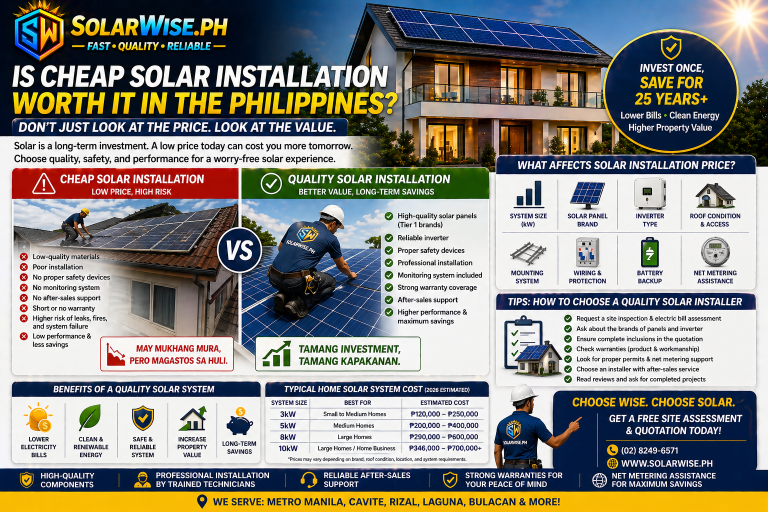
The short answer: in 2026, a complete residential solar power system in the Philippines may cost around ₱120,000 to ₱750,000+, depending on system size, equipment quality, roof condition, inverter type, battery backup, and installation requirements. Some 2026 Philippine solar pricing guides estimate complete residential systems at around ₱55 to ₱75 per watt installed, while other updated market guides show many 3 kW to 10 kW on-grid systems ranging from about ₱150,000 to ₱540,000+ depending on setup and region.
This complete guide will help you understand the solar installation cost Philippines, system size options, on-grid vs hybrid pricing, net metering, and how to choose the best solar setup for your home.
How Much Is the Solar Panel Price Philippines in 2026?
The solar panel price Philippines depends on whether you are buying only solar panels or a complete installed solar power system.
For homeowners, the more important cost is the complete installed system, because this includes solar panels, inverter, mounting structure, wiring, protection devices, labor, testing, and system commissioning.
Here is a practical 2026 residential solar cost guide:
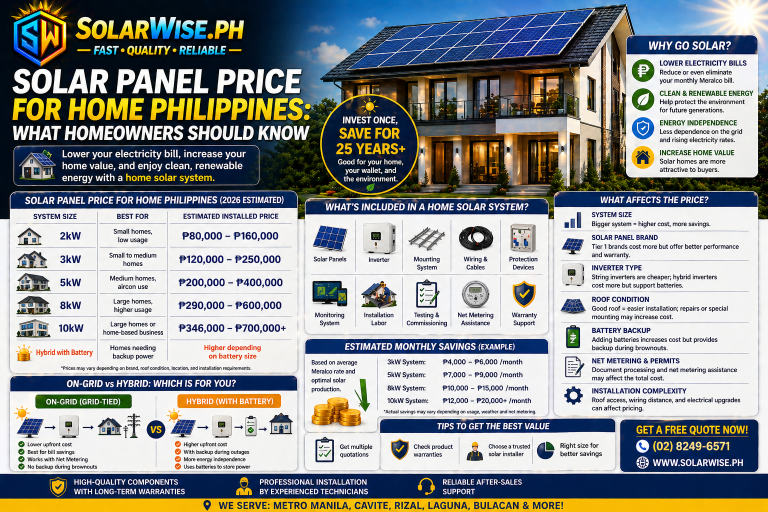
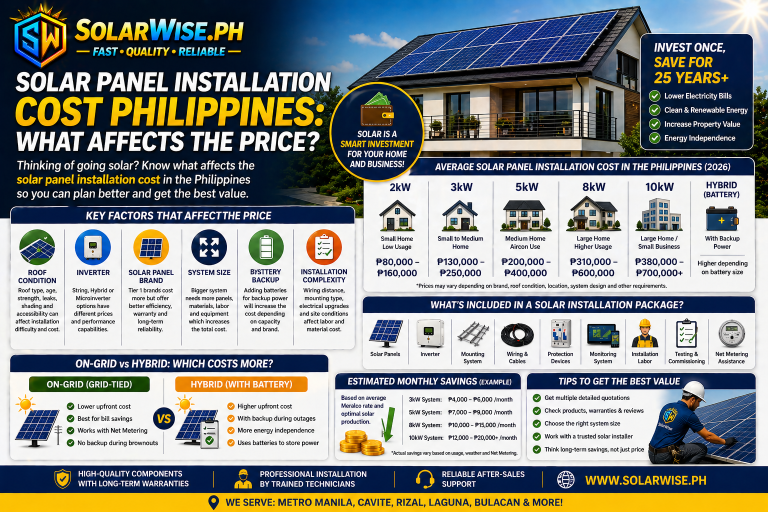
| Solar System Size | Best For | Estimated Installed Cost |
|---|---|---|
| 2 kW | Small homes, low usage | ₱100,000 – ₱160,000 |
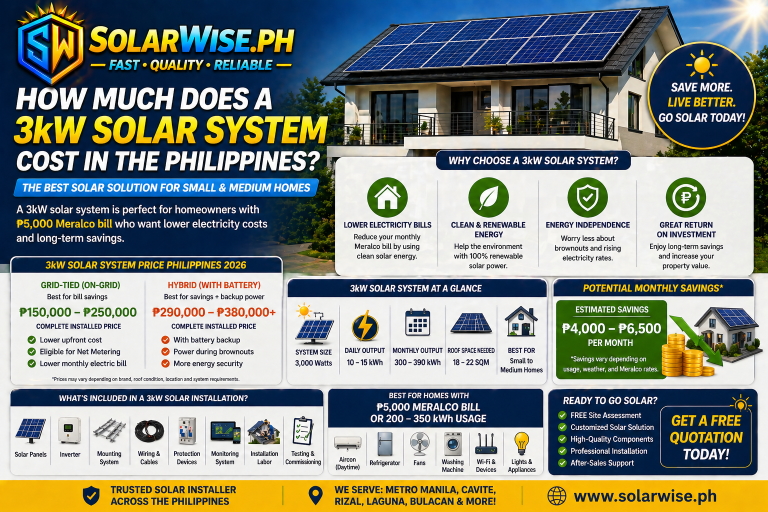
| 3 kW | Small to medium homes | ₱150,000 – ₱250,000 |
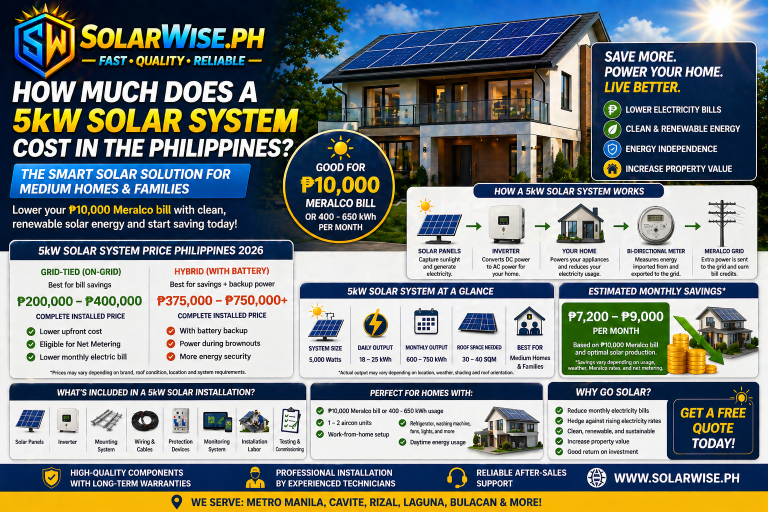
| 5 kW | Medium homes with aircon use | ₱250,000 – ₱400,000 |
| 7 kW | Larger homes with higher usage | ₱350,000 – ₱500,000 |
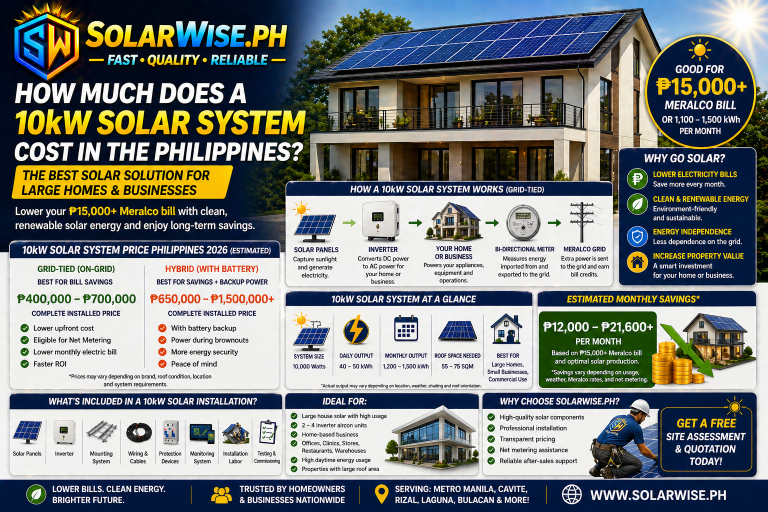
| 10 kW | Large homes or home-based businesses | ₱450,000 – ₱700,000+ |
| Hybrid with batteries | Homes needing backup power | Higher depending on battery size |
These are estimated prices only. Actual cost may vary based on your location, roof type, system design, inverter brand, panel brand, and whether you need batteries.
Solar Installation Cost Philippines: What Is Included?
When comparing solar quotations, huwag lang tingnan ang number of panels. Dapat malinaw kung ano ang included sa package.
A complete solar installation cost Philippines package usually includes:
Solar panels
Inverter
Mounting rails and brackets
DC and AC wiring
Breakers and protection devices
Grounding system
Monitoring system or app
Installation labor
Testing and commissioning
Basic system orientation
Warranty documents
Optional net metering assistance
Optional battery backup for hybrid systems
A cheaper quote may look attractive, but it may exclude important items such as protection devices, proper mounting, monitoring, permits, or net metering assistance. Always ask for a detailed breakdown.
Solar Panels for Home: What Size Do You Need?
The best solar system size depends on your monthly electric bill, kWh consumption, roof space, daytime usage, and budget. Hindi dapat hulaan ang system size. Dapat ito ay based sa actual Meralco bill or utility bill mo.
Here is a simple guide for solar panels for home:
| Monthly Electric Bill | Suggested Solar Size |
|---|---|
| ₱3,000 – ₱5,000 | 2 kW – 3 kW |
| ₱5,000 – ₱8,000 | 3 kW – 5 kW |
| ₱8,000 – ₱12,000 | 5 kW – 7 kW |
| ₱12,000 – ₱18,000 | 7 kW – 10 kW |
| ₱18,000 and above | 10 kW and above |
For many Filipino homes, a 3 kW to 5 kW solar power system is a common starting point. Larger homes with multiple aircons, water pumps, refrigerators, and work-from-home setups may need 5 kW to 10 kW or higher.
Estimated Monthly Savings from Solar Panels
Your solar savings depend on system size, electricity rate, daytime usage, shading, roof angle, weather, and net metering approval.
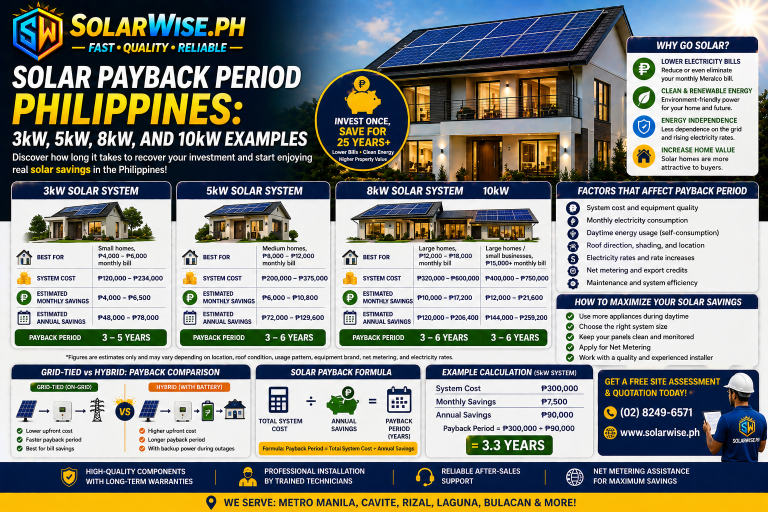
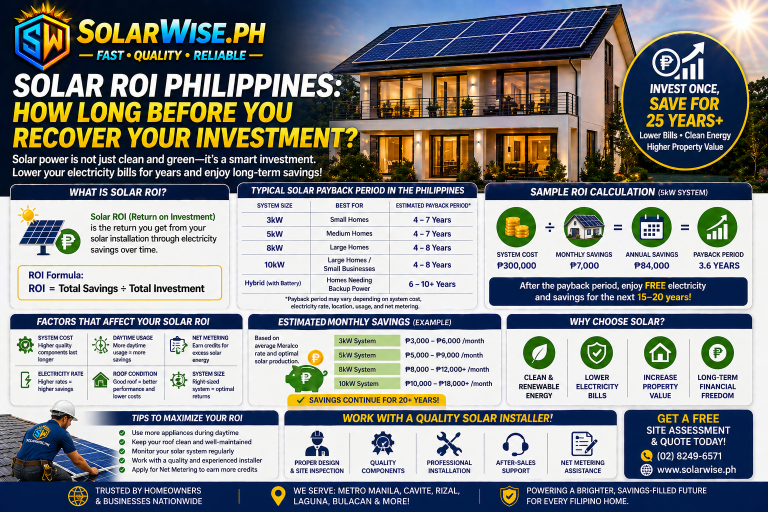
One 2026 Philippine solar guide estimates typical monthly savings at around ₱4,459 for 3 kW, ₱7,432 for 5 kW, ₱11,891 for 8 kW, and ₱14,864 for 10 kW, though actual savings vary by utility rate and usage pattern.
In real life, solar does not always mean zero bill. You may still pay for nighttime usage, minimum charges, grid charges, taxes, and electricity used when solar production is low.
The best savings usually happen when your home uses electricity during the day, while the solar panels are producing power.
On-Grid Solar System Price Philippines
An on-grid or grid-tied solar system is usually the most affordable and practical setup for homeowners whose main goal is lower monthly electricity bills.
An on-grid system is connected to your home and the utility grid. During the day, your home uses solar power first. If solar production is not enough, the grid supplies the remaining electricity. If your system produces excess power and is approved for net metering, the extra energy may be exported to the grid for bill credits.
Estimated on-grid solar pricing:
| On-Grid System Size | Estimated Cost |
|---|---|
| 3 kW | ₱150,000 – ₱250,000 |
| 5 kW | ₱250,000 – ₱400,000 |
| 7 kW | ₱350,000 – ₱500,000 |
| 10 kW | ₱450,000 – ₱700,000+ |
Choose on-grid solar if your priority is lower upfront cost and better bill savings.
Hybrid Solar System Price Philippines
A hybrid solar system includes battery storage. This setup is more expensive, but it can provide backup power during brownouts.
Hybrid solar is ideal if you want to power essential loads such as:
Lights
Wi-Fi router
CCTV
Refrigerator
Electric fans
Laptop or work-from-home setup
Selected outlets
Estimated hybrid solar pricing:
| Hybrid System Size | Best For | Estimated Cost |
|---|---|---|
| 3 kW Hybrid | Small homes, essential backup | ₱250,000 – ₱450,000 |
| 5 kW Hybrid | Medium homes, backup loads | ₱400,000 – ₱750,000 |
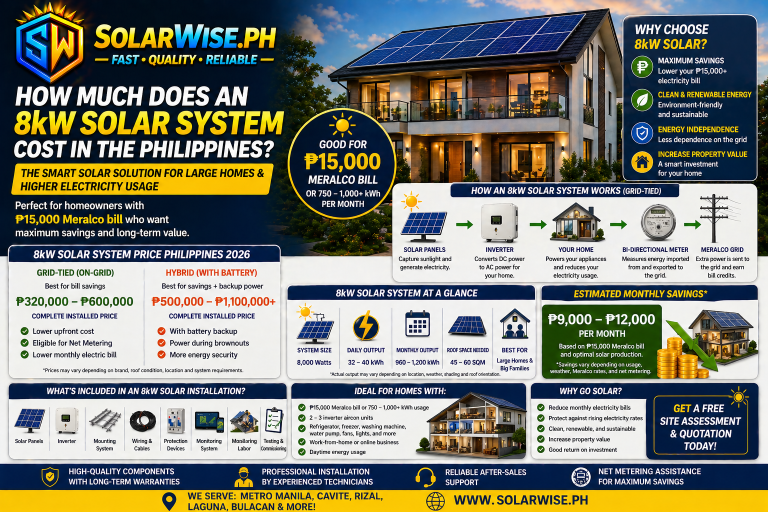
| 8 kW Hybrid | Larger homes, higher usage | ₱700,000 – ₱1,100,000+ |
| 10 kW Hybrid | Large homes or home-based businesses | ₱900,000 – ₱1,500,000+ |
Battery size has a big effect on price. The more backup power you want, the higher the total system cost.
What Affects Solar Panel Price in the Philippines?
Several factors affect the final solar panel price Philippines homeowners will pay.
1. System Size
Larger systems need more panels, larger inverter capacity, more mounting materials, more wiring, and more labor.
2. Solar Panel Brand
Tier 1 solar panel brands usually cost more but may offer better performance warranties and long-term reliability. Some Philippine guides list common panel brands such as Jinko, LONGi, JA Solar, and Canadian Solar in the local market.
3. Inverter Type
String inverters are usually more affordable. Hybrid inverters cost more because they can work with batteries. Microinverters or optimizers may also increase cost but can help with shaded or complex roofs.
4. Roof Type and Condition
Metal roofs, concrete roofs, tile roofs, and steep roofs require different mounting methods. If the roof needs repair or reinforcement, this can add cost.
5. Shading and Layout
Trees, nearby buildings, water tanks, and antennas can reduce solar production. A proper site inspection helps avoid poor system performance.
6. Battery Backup
Batteries are one of the biggest cost add-ons. If your goal is only bill savings, you may not need batteries. If your goal is backup power during outages, hybrid solar may be worth it.
7. Net Metering Assistance
For grid-tied systems, net metering can help convert excess solar power into bill credits. Some installers include net metering assistance, while others charge separately.
Solar Panel Price by Location in the Philippines
Installation cost may vary depending on location, labor, roof access, logistics, and utility requirements.
Metro Manila
Metro Manila installations may cost slightly higher because of labor, access, traffic, roof complexity, and dense urban conditions. A 2026 solar pricing guide notes that NCR installations can run about 10% to 15% higher than some other regions due to labor cost factors.
Target areas include Quezon City, Makati, Taguig, Pasig, Mandaluyong, Manila, Las Piñas, Muntinlupa, Parañaque, and Alabang.
Cavite
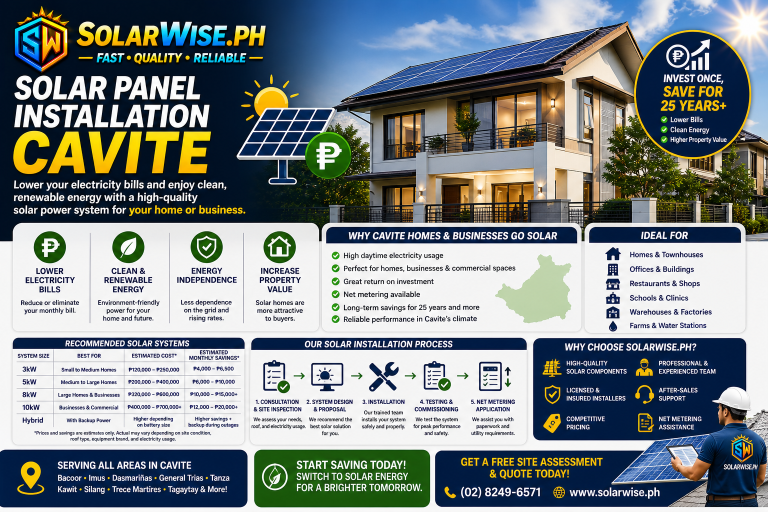
Cavite homes in Bacoor, Imus, Dasmariñas, General Trias, Tanza, Silang, Kawit, and Trece Martires often have good roof space for solar panels. Solar can be ideal for subdivisions, townhouses, and home-based businesses with daytime usage.
Rizal
Rizal homes in Antipolo, Cainta, Taytay, Angono, Binangonan, San Mateo, and Rodriguez can also benefit from rooftop solar. Proper roof inspection is important, especially for homes near trees, hillsides, or shaded areas.
Laguna and Bulacan
Homes in Laguna and Bulacan may also benefit from residential solar, especially properties with large roofs and high daytime consumption.
Is Net Metering Included in the Price?
Not always. Net metering assistance may or may not be included in your quotation.
Net metering allows qualified solar homes to export excess solar power to the grid and receive bill credits. Meralco states that eligible renewable energy facilities up to 100 kW may export excess electricity, with the corresponding value credited to the customer’s next bill.
Before signing a quote, ask your installer:
Is net metering assistance included?
Who prepares the documents?
Is CFEI assistance included?
Who handles utility coordination?
Are permit fees included or separate?
Will the system be net-metering-ready?
Is Solar Worth It for Filipino Homeowners in 2026?
Yes, solar can be worth it if your electricity bill is consistently high and your roof has good sunlight exposure.
Solar is ideal for:
Homes with monthly bills above ₱5,000
Families using aircon during the day
Work-from-home households
Homes with refrigerators, pumps, and appliances
Properties with wide roof space
Homeowners planning to stay long-term
Home-based businesses
Small commercial spaces
Solar may not be ideal if your roof is heavily shaded, your monthly bill is very low, or you plan to move soon.
How to Compare Solar Quotes
When comparing solar quotes, look beyond the total price.
Check the following:
System size in kW or kWp
Number and wattage of panels
Panel brand and warranty
Inverter brand and warranty
Mounting system quality
Protection devices included
Monitoring system included
Workmanship warranty
Net metering assistance
Estimated production
Estimated savings
After-sales support
Payment terms
A good installer should explain why a certain system size is recommended based on your actual usage.
Common Mistakes to Avoid
Choosing the Cheapest Quote Only
Cheap systems may exclude important safety devices or use lower-quality components.
Oversizing the System
Bigger is not always better. A properly sized system usually gives better value than an oversized system with too much unused export energy.
Ignoring Roof Shading
Shading can reduce solar production. Always request a roof inspection.
Not Asking About Net Metering
For grid-tied systems, net metering can help maximize savings from excess solar energy.
Expecting a Guaranteed Zero Bill
Solar can reduce your bill significantly, but zero bill is not always guaranteed.
Frequently Asked Questions
How much is the solar panel price Philippines in 2026?
A complete residential solar power system in the Philippines may cost around ₱120,000 to ₱750,000+ depending on system size and setup. A typical 3 kW system may cost around ₱150,000 to ₱250,000, while a 5 kW system may cost around ₱250,000 to ₱400,000.
How much is solar installation cost Philippines?
Solar installation cost in the Philippines depends on system size, equipment brand, roof condition, and installation complexity. Some 2026 guides estimate on-grid installation at around ₱55,000 to ₱75,000 per kW, while other market guides show lower ranges depending on region and equipment.
How many solar panels do I need for a home?
It depends on your electricity usage and panel wattage. A 3 kW system may use around 5 to 7 panels, while a 5 kW system may use around 9 to 12 panels depending on the panel capacity.
Is 3 kW solar enough for a home?
A 3 kW solar system may be enough for small to medium homes with moderate daytime usage. Homes with multiple aircons or higher bills may need 5 kW or more.
Is 5 kW solar enough for a Filipino home?
A 5 kW solar system is a common choice for medium homes with aircon use, work-from-home equipment, refrigerators, and higher daytime electricity usage.
Do I need batteries for solar panels for home?
Not always. If your goal is lower electricity bills, an on-grid solar system may be enough. If you want backup power during brownouts, choose a hybrid system with batteries.
Can solar panels make my electric bill zero?
Sometimes, but not always. You may still pay for nighttime usage, grid charges, taxes, minimum charges, and electricity used when solar production is low.
What is the best solar setup for home Philippines?
For most homeowners, a properly sized on-grid solar system is the most cost-effective setup. For homes that need backup power, a hybrid solar system with batteries may be better.
Conclusion
The solar panel price Philippines in 2026 depends on your system size, roof condition, equipment quality, inverter type, and whether you choose on-grid or hybrid solar. For many Filipino homeowners, a complete residential solar system may range from around ₱120,000 to ₱750,000+, with 3 kW to 5 kW systems being common for typical homes.
If your main goal is lower monthly electricity bills, an on-grid solar system is usually the best starting point. If you want backup power during brownouts, a hybrid solar system with batteries may be worth the added cost.
Before installing, start with an electric bill assessment and site inspection. This ensures your solar power system is properly sized, safely installed, and designed for long-term savings.